

Morocco
An introduction to a country that resists simple description
Morocco is the country that the Arab geographers called Al-Maghreb al-Aqsa — the Farthest West of the Islamic world. It sits at the north-western corner of Africa, separated from Spain by fourteen kilometres of water at its narrowest point, bordered to the south and east by Algeria and, beyond that, the Sahara. It is the only country in the world, apart from Spain and France, to have coastlines on both the Atlantic Ocean and the Mediterranean Sea. That geography — straddling continents, facing two seas, backed by mountain ranges that include the highest peak in North Africa — has shaped everything about Morocco: its history, its culture, its people, and the startling variety of landscapes you can cross in a single day’s drive.
Contents
- Introduction
- Lie of the Land
- Eleven Centuries of Dynasties
- Culture Faith & Daily Life
- Moroccan Food Guide
- Highlights
- Tangier
- Fez
- Meknés
- Marrakesh
- Essaouira
- Chefchouen
- Taroudant
- Tétouan
- Ouarzazate
- Rabat
- Casablanca
- Agadir
- Merzouga and the Sahara
- Practical Tips for Independent Travellers
6. Itineraries
We have five Itineraries in Morocco;
- One week in the North ; Tangier to Meknés
- One Week in the South; Marrakesh to Agadir
- Two weeks from Tangiers to Marrakesh
- Three weeks – The two week Itinerary plus an excursion into the High Atlas
- Four weeks- The detailed itinerary from Tangier, through the Imperial Cities then through the Atlas to the edge of the Sahara, and finishing in Marrakesh
Introduction
I have been coming to Morocco for the last thirty years, initially to source new producers and new products for my fair trade business One World is Enough.
Every year we try to visit our producers to work on new products and sort out any problems. Over the years of visting and getting to know Morocco I have fallen in Love with the country, the people and the food!
It is one of those countries that is both immediately welcoming , but the more you explore off the beaten track, the more rewarding your travels become.
You think you understand it, and then you turn a corner, or sit down at a table, or arrive in a town you had not expected to stop in, and you realise you have barely started.
This is a country that keeps pulling you back, and each time you visit you discover something new.
The Lie of the Land
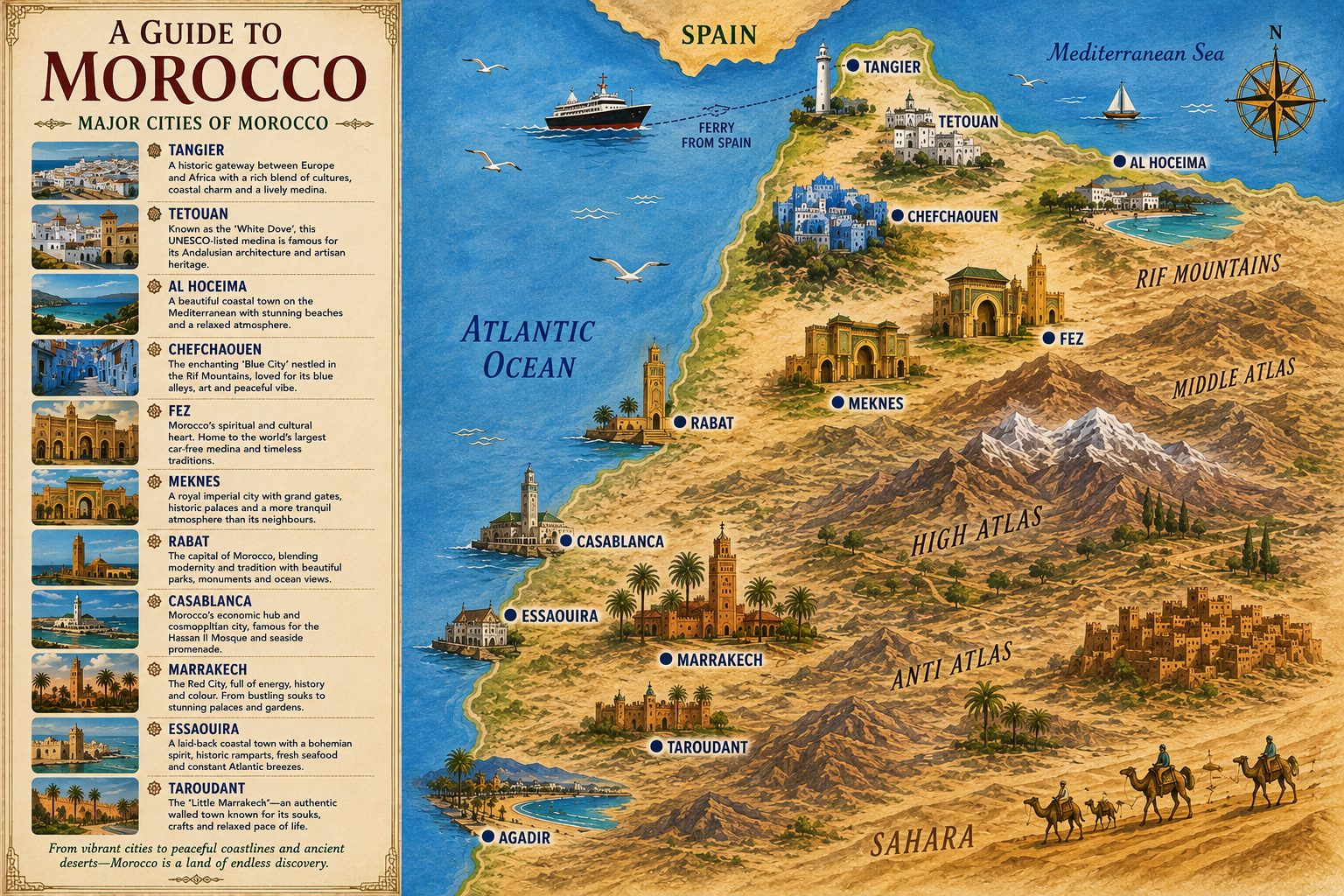
The first thing to understand about Morocco is that it is not one landscape. It is five or six, compressed into a country roughly the size of France, and the transitions between them are often sudden enough to be theatrical.
The northern and western coasts — Atlantic and Mediterranean — are mild, green and humid by North African standards. The Rif Mountains in the north are densely forested and startlingly reminiscent, in spring, of parts of southern Europe: cedar and pine, clear rivers, cool air. Move south and inland and you encounter the Middle Atlas, then the High Atlas — the great mountain spine of the country, stretching seven hundred and fifty kilometres from the Atlantic coast to the Algerian border. The High Atlas contains Jbel Toubkal, at 4,167 metres the highest peak in North Africa, and holds snow well into spring. The Atlas ranges are not a backdrop to Morocco; they are its backbone, the geological fact around which everything else is organised.
East and south of the High Atlas, the landscape becomes something different entirely. The pre-Saharan valleys — the Draa, the Dades, the Ziz — are linear oases of date palms and mud-brick kasbahs running through an increasingly arid terrain. Further still, the Sahara itself: the great sand-dune ergs of Erg Chebbi near Merzouga, where the dunes rise to nearly two hundred metres and the silence at night is total.
Between and among all of this are the Atlantic plains — fertile, agricultural, dotted with argan trees and olive groves — and the great imperial cities that the various dynasties built across eleven centuries of Islamic rule. Morocco is a country where you can ski in the morning and reach the edge of the Sahara by nightfall. That is not a marketing proposition. It is a geographical fact, and it matters to understanding why Morocco is the way it is.
Getting around: Morocco has an excellent train network linking the major Atlantic coast cities, but much of the country’s most interesting terrain is only accessible by road. A good driver-guide is worth the investment for the south and east; for the north and the imperial cities, the train is perfectly adequate.

Eleven Centuries of Dynasties
Morocco’s modern name in English comes, via Spanish, from Marrakesh — which was the capital of successive dynasties and gave its name, in the eyes of medieval European traders and travellers, to the whole country. The country’s own name for itself is Al-Maghreb, the West, which locates it precisely in its historical and geographical relationship to the wider Islamic world: Morocco is where the Arab world ends, the point at which Islam reached the Atlantic and, in 711 AD, crossed it to begin seven hundred years in the Iberian Peninsula.
Culture, Faith and Daily Life
Morocco is a predominantly Muslim country, and Islam shapes its rhythms in ways that are entirely visible to the visitor. The call to prayer five times daily is not background noise; it is the structure around which the day is organised. Ramadan changes the character of cities profoundly — a daytime quiet giving way to an extraordinary nocturnal energy after iftar. The great religious festivals — Eid al-Fitr, Eid al-Adha — are occasions of family, food and generosity that visitors who are lucky enough to be present will not forget.

Moroccan Food
Moroccan cuisine is one of the great cuisines of the world, and I say that without hyperbole. The tagine — slow-cooked in a conical clay vessel over charcoal, with combinations of meat, preserved lemon, olives, dried fruit and spice that seem improbable until you eat them — is a cooking technique of genius. Couscous, always eaten on Fridays, is a dish that rewards patience: the best versions are steamed three times and have a lightness that the European imitations never approach. Pastilla — the extraordinary pigeon or chicken pie encased in paper-thin warka pastry, dusted with icing sugar and cinnamon — is a reminder that Moroccan cooking has never been afraid of combining what European cuisines have decided must be kept apart. Eat where the locals eat, or in riads whose owners care about food, and you will eat very well.
Click here to visit our Moroccan Food guide
The Highlights
Morocco has nine cities that any visitor with a serious interest in the country should know about. They are very different from each other — the imperial splendour of Fez bears almost no resemblance to the whitewashed Atlantic calm of Essaouira, and the mountain dreamscape of Chefchaouen is another Morocco again. What follows is an honest portrait of each, and what they offer.


Tangier occupies a position of almost mythological significance in the Western imagination, largely because of the writers, artists and assorted disreputables who congregated here in its International Zone years between 1923 and 1956, when it was administered jointly by the colonial powers and operated as a place where the rules of every nation applied and therefore, in practice, none did. Burroughs, Bowles, Ginsberg, Matisse — the roll-call of creative visitors is long and its legacy is visible in the cafes of the medina, if you know where to look.
The real Tangier is something different: a working port city of genuine energy, shaped by its proximity to Europe and its role as the crossing point between two continents
Click here to read our guide to Tangier

Fez – The World’s Oldest Living Medieval City
If you could only visit one Moroccan city other than Marrakesh, I would strongly recommend that you visit Fez.
It is amazing, when you step foot into it’s huge medina, it is as if you have stepped back 500 years, to medieval times where tradesmen sell their exotic handmade goods. The medina is a labyrinth of small passageways lined with stalls and small shops, some just rooms filled with the most amazing handmade crafts. The medina is divided into different areas, each trade has it’s own area of the medina, where traders compete vigorously with each other for your custom.
And the traders are persistent, I have been followed through the medina by a trader selling traditional sandals that I glanced at in passing. He followed me for a good fifteen minutes, I wasn’t really that interested in the sandals, but we haggled and I got such a good price that I bought them. I’m glad I did, they were the best sandals I ever owned!
I found the medina quite overwhelming, the first time I visited, all your senses become hyper vigilant. It was like stepping into the fairytale world of the Arabian Nights.
It was amazing for a person like me who works with traditional artisans, to step back into a time where everything was handcrafted by traditional tradesmen.
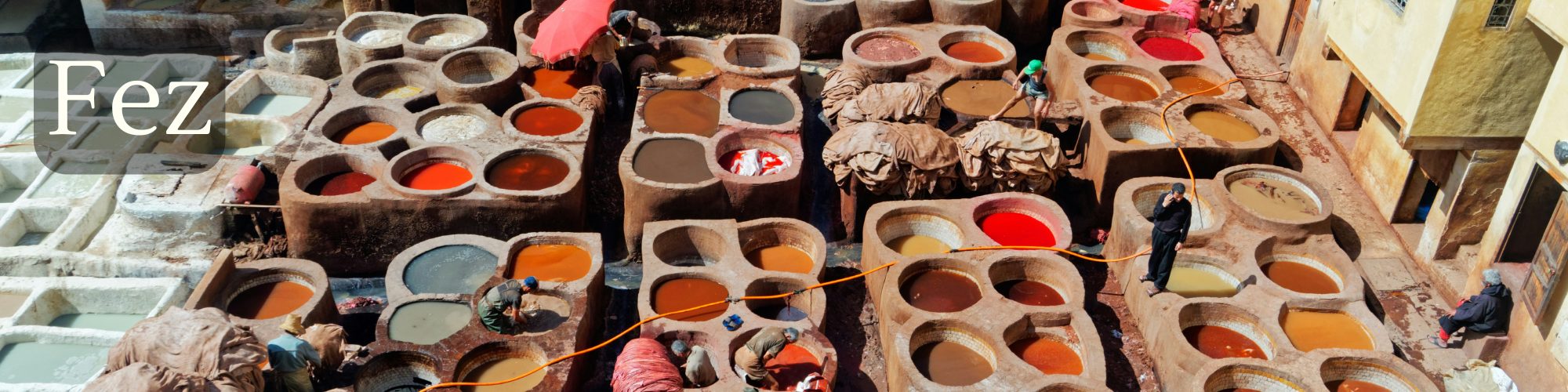
Fez or Fes is by some measures, the oldest continuously inhabited city in the world, and its ancient medina — the Fes el-Bali — is the largest car-free urban area on earth. There are no wheeled vehicles in most of it. Goods are moved by donkey. The tanneries have been producing leather in the same dye vats, using the same methods, since the eleventh century. The Qarawiyyin mosque — founded in 859 AD — contains a library that is sometimes claimed to be the oldest in the world, and a university whose founding predates Oxford by three centuries.


Meknès – The Forgotten Imperial City
Meknès is the most undervisited of Morocco’s four imperial cities, and that is both its misfortune and the visitor’s considerable gain. Built by the sultan Moulay Ismail in the late seventeenth and early eighteenth centuries as his attempt to create a Moroccan Versailles — he was a contemporary of Louis XIV and was not immune to the competitive instincts of absolute monarchs — it is a city of enormous gates, vast granaries, royal stables, and walls that stretch for forty kilometres around the old city.
The Bab Mansour gate is one of the finest examples of Moroccan monumental architecture in existence: a triumphal arch of extraordinary scale, covered in zellige tilework and carved stucco that manages to be simultaneously overwhelming and beautiful. The medina, smaller and less labyrinthine than Fez, has a genuine local character that the more touristed cities have somewhat lost. The food market in the Djemaa el-Hedim square in the evening is one of the most pleasurable experiences in Moroccan city life: unpretentious, local, excellent.
Meknès also sits thirty kilometres from Volubilis, the Roman city, making the two an obvious day’s combination. Visit Volubilis in the morning, Meknès in the afternoon and evening, and stay the night. You will have it largely to yourself.


Marrakesh – The Iconic Red City
Marrakesh is a bewildering assault on all your senses, all at the same time, sometimes it can be hard to take it all in. It is best to stop trying to process it and just immerse yourself in all the sights, sounds & smells .
In the ancient souks of Marrakesh you feel as if you are an extra in the 1001 Arabian Nights, as if you have been transported back in time to a time when talented artisans sold the things that they had made themselves, either on their stalls in the markets or if they couldn’t afford a stall then from a blanket on the ground.
In fact it is not far from the truth. In our recent trip to Marrakesh, we discovered a whole warren of workshops in the back streets where artisans were making all nature of handmade goods, from metal lamps to furniture.
We came back with a container load of Moroccan Candle Lanterns, amazing star shaped lampshades and those big hand cut lampshades with coloured glass that grace the stairwell of the ancient riads.


Essaouira – Beautiful Fishing Port on the Atlantic Coast
Three hours west of Marrakesh on the wild Atlantic coast, Essaouira is the most relaxed city in Morocco one of the most beautiful, and a complete contrast to Marrakesh. Its medina — a UNESCO World Heritage Site, built by the Portuguese in the sixteenth century and significantly rebuilt in the eighteenth — is laid out on a grid, which makes it immediately less disorienting than the organic labyrinths of Fez or Marrakesh, and its white and blue architecture has a clarity and airiness that reflects both its Atlantic position and its complex cultural history.
Whenever I visit Marrakesh I always allow a few days rest and recuperation in Essaouira, the two places are polar opposites and complement each other perfectly. After a week in the heat and hyperactivity of Marrakesh, Essaouira is the perfect place to recuperate. It’s a lovely temperature, cooled by Atlantic breezes, it has a small medina with mighty ramparts, right next to the sea and has a huge expanse of golden sand where you can usually see camel herders selling camel rides across the beaches.
It’s a lovely walk along the beach to the village of Diabat where Jimi Hendrix, Cat Stevens and lots of hippies holed up to escape getting drafted into the US army to go and fight in the Vietnam War. There’s even a ruined palace hidden amongst the dunes.


Chefchaouen sits in the Rif Mountains of northern Morocco, founded in 1471 as a stronghold against Portuguese incursions and later swelled by refugees from the fall of Granada — which accounts for the Andalusian character of much of its architecture. Its medina is painted in extraordinary shades of blue: indigo, cobalt, powder blue, cornflower, the colour of deep water. The reason for the blue is debated — Jewish residents are credited by some historians, a twentieth-century mayor by others — but the effect is undeniable. It is one of the most photogenic places in Morocco, which means it is now heavily visited, which means that the medina on a summer afternoon can be surprisingly crowded for a city of its size.
The answer is to arrive early and stay late. The Rif Mountains that surround the city are spectacular walking country, and the walk up to the ruined Spanish mosque above the town — an hour on foot — gives you views over the medina and the valley that justify the effort entirely. The Friday market, when Amazigh women from the surrounding villages bring produce and textiles to sell, is one of the most authentic market experiences in northern Morocco.
Chefchaouen also has a particular atmosphere that I have not found anywhere else: unhurried, slightly otherworldly, as if the blue paint has seeped into the pace of life. I would recommend spending two nights here to fully appreciate it.
Taroudant – Little Marrakesh
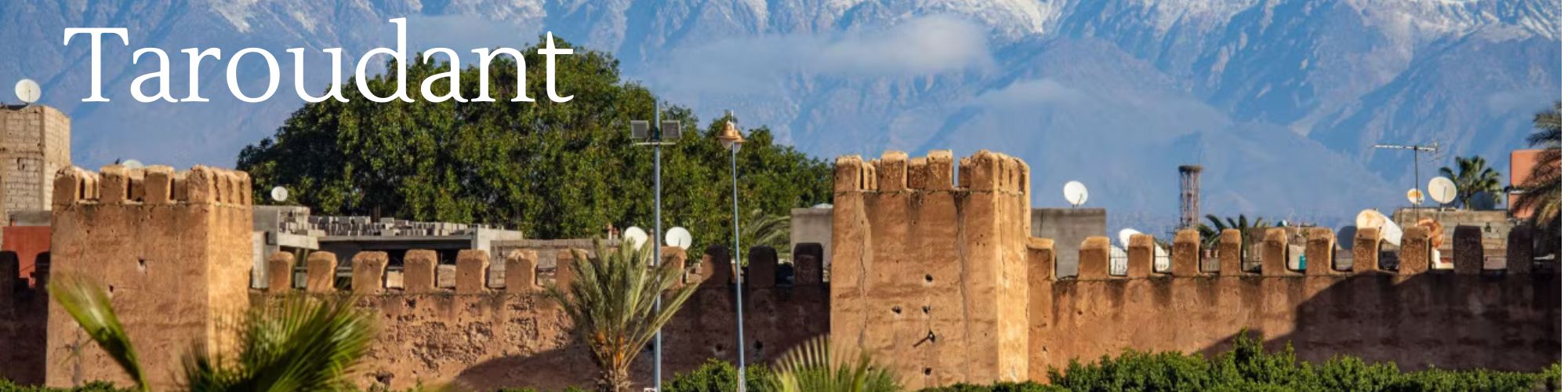
Taroudant is the secret that people who know Morocco well tend to keep to themselves, or share only with travellers they trust to appreciate it. Situated in the fertile Sous valley with the High Atlas mountains to the north and the Anti-Atlas to the south, it was the first capital of the Saadian dynasty in the sixteenth century — the dynasty that would go on to build El Badi Palace in Marrakesh and defeat Portugal at the Battle of the Three Kings. The honey-gold ramparts that enclose the old city are among the best-preserved in Morocco.
Its nickname — Little Marrakesh — refers to its walled, red-earth aesthetic, but the comparison flatters both cities in different directions. Taroudant has the architecture without the crowds. Its souks are genuine working markets rather than tourist destinations. The pace of life is slower, more authentic, this is how Morrocco was before package holiday makers started coming for weekend breaks. I have found it, on repeated visits, one of the most restorative places in the country.
The Palais Salam hotel — a converted pasha’s palace set within the ramparts — is worth staying in even if palatial hotels are not usually your style. The evening light on the walls as you walk the circumference of the ramparts at dusk is the kind of thing that stays with you.

Tétouan — The Andalusian City
Tétouan, just south of the Spanish enclave of Ceuta in the far north, is one of the most Spanish-feeling cities in Morocco — not because of the Spanish colonial presence but because of the Andalusian refugees who settled here after 1492 and maintained their culture for centuries. The medina, a UNESCO World Heritage Site, has an architecture and a street pattern distinctly different from the imperial cities of the south. It is relatively little visited, entirely authentic, and one of the more remarkable examples in the world of a transplanted culture taking deep root.
Click here to visit our detailed guide to Tétouan
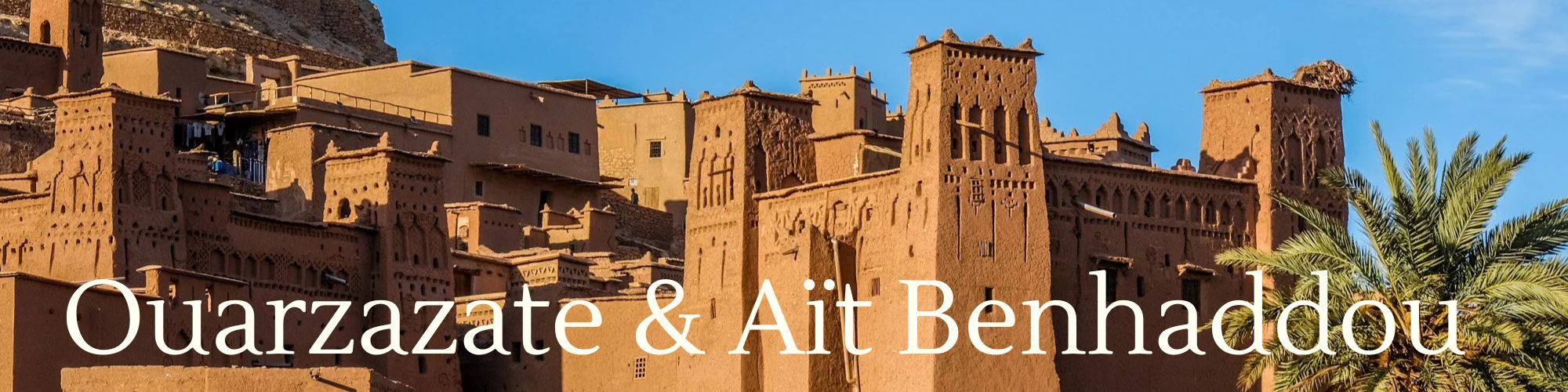
Ouarzazate & Aït Benhaddou
Ouarzazate — pronounced, roughly, war-za-zat — sits on a high plateau south of the High Atlas, at an altitude of over 1,100 metres, and serves as the gateway to both the Draa Valley and, ultimately, the Sahara. It has acquired a secondary fame as a film location: the landscape and the pre-Saharan light have attracted productions from Lawrence of Arabia to Gladiator to Game of Thrones, and the Atlas Film Studios, on the edge of town, claim to be the largest in the world. The studios are worth a visit if you are curious about how the desert gets turned into ancient Rome or Westeros; if you are not, skip them and spend the time at Aït Benhaddou instead.
Aït Benhaddou is a ksar — a fortified village of mud-brick towers — that sits on the old caravan route between the Sahara and Marrakesh. It is a UNESCO World Heritage Site and one of the most extraordinary pieces of vernacular architecture in North Africa: a whole community built from the earth beneath it, the towers rising from the hillside in shades of ochre and terracotta that change with the light. Most of it is now unoccupied — a living museum rather than a living village — but a small number of families remain in residence on the far bank of the river, and crossing to meet them is the best part of the visit.
From Ouarzazate, the Draa Valley extends south for over 200 kilometres to Zagora — a long river valley of date palms, ancient ksour and mud-brick villages that gives a more intimate encounter with the pre-Saharan world than the dunes of Merzouga.

Casablanca – Morocco’s Largest City
The first thing to say about Casablanca is that it has nothing to do with the film. Humphrey Bogart was never here. Rick’s Café is a reconstruction built in 2004 by an American diplomat who had always wanted to run a bar. The film was shot entirely in Hollywood, and the director Michael Curtiz never visited Morocco. The city’s global name recognition comes entirely from a work of fiction, and the actual Casablanca — Morocco’s largest city, its economic capital, its primary port, the home of a third of its industrial output — is a very different proposition from the cinematic version.
Which is not to say it is uninteresting. Casablanca is the most modern city in Morocco, the most economically significant, and in some ways the most revealing. It is where the country’s ambitions for the twenty-first century are most legibly written — in the new financial district, in the port developments, in the ambitious urban renewal projects. It is also where the contradictions of modern Morocco are most visible: extreme wealth and significant poverty in proximity, a young population caught between tradition and modernity, a city that has grown faster than its infrastructure can comfortably contain.
Click here to visit our detailed guide to Casablanca

Rabat — The Undervisited Capital
Morocco’s capital is systematically undervisited, which is curious given that it contains some of the finest monuments in the country. The Hassan Tower — an unfinished twelfth-century minaret that would, had it been completed, have been the tallest building in the world at the time — stands in a field of broken columns that has an elegiac beauty unlike anything in the more celebrated cities. The Mausoleum of Mohammed V, which adjoins it, is a work of contemporary Moroccan craftsmanship of genuine quality. The Kasbah of the Udayas, a medieval fortress above the mouth of the river, contains a garden and residential quarter of great charm. I would definitely recommend spending a couple of days in Rabat.
Click here to visit our detailed guide to Rabat

Agadir – A City Rebuilt from Catastrophe
Agadir has in recent years become a destination for package holiday makers. It is not, in the conventional sense, a culturally rich destination. There is no historic medina — the 1960 earthquake destroyed the old city in fifteen seconds, killing twelve thousand people, and the city was rebuilt from scratch on a modern grid plan. There are no imperial monuments, no ancient souks, no labyrinthine lanes.
What Agadir has, and has in abundance, is ten kilometres of Atlantic beach, three hundred days of sunshine a year, a warm and reliable climate, an excellent harbour, and proximity to some of the most interesting landscapes in southern Morocco.
I include Agadir in this guide because it is part of Morocco’s story — because the earthquake and its aftermath are as much a part of that story as any dynasty’s architecture, and because the city has genuinely interesting dimensions that the beach-resort reputation tends to obscure.
The Souss valley, the Anti-Atlas mountains, the argan forest, the Amazigh culture of the region around the city: all of these are accessible from Agadir, and all of them are worth the journey.
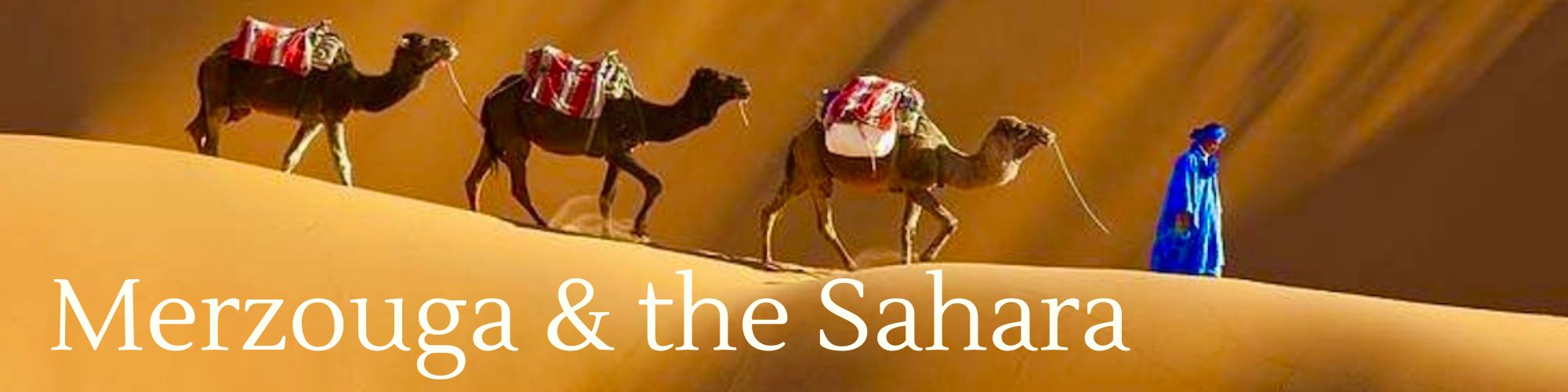
The Sahara — Merzouga and Erg Chebbi
The dunes at Merzouga — Erg Chebbi — are the great sand-dune field of Morocco, rising to nearly two hundred metres at their highest and stretching south into Algeria.
The experience of being in them at dawn or dusk, when the light rakes across the sand and the temperature drops sharply, defies description.
It has become a bit of a tourist destination; there are camel trains and desert camps with varying levels of comfort but it is still worth going. The scale of the Sahara dunes overpowers anything man made.
Although it is a bit of a trek, the journey to Merzouga is well worth the effort
Click here to Visit our detailed guide to Merzouga & The Sahara

Our Itineraries around Morocco
Our itineraries are guides to how I would spend a week, or more touring Morocco, trying to see as much as is possible in the time you have available. The travelling is part of the experience, I always want to see as much as possible without the actual travelling becoming a chore. Sometimes I think you discover more about a country by spending a few days in one place rather than racing around trying to tick of as many sights as possible.
But it’s your trip and we are all different, so use these itineries as a suggestion. I would urge you to be flexible, Morocco has a way of getting you to change course — an unexpected conversation in a medina lane, a tannery you stumble into by accident, a café that turns out to be the best you have encountered anywhere — and the traveller who holds too tightly to the plan tends to miss the best , most authentic, most unique experiences. What follows, then, is a framework. It gives you a structure and a logic, a way of moving through the country that makes geographical sense. But be flexible and be prepared to alter your plans.
Each itinerary below has been designed with several principles in mind. The journey should flow — each stage connecting naturally to the next, with no unnecessary doubling back. I have tried to make the pace relaxed — two nights in a place is generally the minimum needed to feel it properly. I have tried to balance the famous sites with those less-visited, especially on the longer itineries. So hopefully you should feel that you have managed to scratch below the surface a little and found at least some of the hidden Morocco.
All five itineraries assume that a visitor, either comes over on the ferry from Algeciras in Spain, which I would personally recommend, otherwise flys into and out of Casablanca, Marrakesh or Agadir all of which have good international connections. Specific entry and exit points plus useful travel tips are noted in the practical sections at the end of each itinerary.
So let me share with you, my curated guides to Morocco, each itinerary includes an interactive google map, links to more detailed guides to each of the cities we visit, a guide to Moroccan food, practical notes on the itinerary plus a bonus practical section on independent travel in Morocco.
Enjoy the experience!
The best seasons for visiting Morocco are April to May and September to October; July and August are hot & crowded and in many cities uncomfortable. February brings almond blossom to the south and occasional snow to the Atlas crossings. December and January are genuinely cold at altitude but often beautifully clear and quiet in the cities.
We have five Itineraries in Morocco;

One week in the North ; Tangier to Meknés
Morocco is a big country, roughly the size of France, it is not possible to visit the whole country in seven days , so we have created two seven day itineraries, one covering the North of Morocco and the other one the South of Morocco.
The north of Morocco is the part of the country that most tourists heading to Marrakesh never see, which means it is more authentic and many places see only a handful of foreign visitors. This itinerary covers the full arc of the northern experience: the cosmopolitan port city of Tangier, the blue dreamscape of Chefchaouen in its Rif mountain bowl, the overlooked Andalusian medina of Tétouan, and the imperial grandeur of Fez, with Meknès and the Roman ruins of Volubilis rounding out the final days. Seven days is quite a tight schedule, and if you have a few more days I would advise spending them relaxing in Fez or Meknès or both.

One Week in the South; Marrakesh to Agadir
The south of Morocco — Marrakesh and the Atlantic coast and the landscapes between them — is the most visited part of the country, for good reason. It is the quintessential Morrocco, it is an area of great variety that really makes you feel as if you have been transported to a foreign and exotic land, far removed from your home country. This itinerary uses Marrakesh as its anchor and gateway, reaches west to Essaouira on the Atlantic, touches the edge of the High Atlas, and ends in Taroudant — the secret that knowing travellers keep to themselves. It is a journey that moves between the famous and the genuinely unknown, between spectacle and intimacy, between the red city and the blue sea.
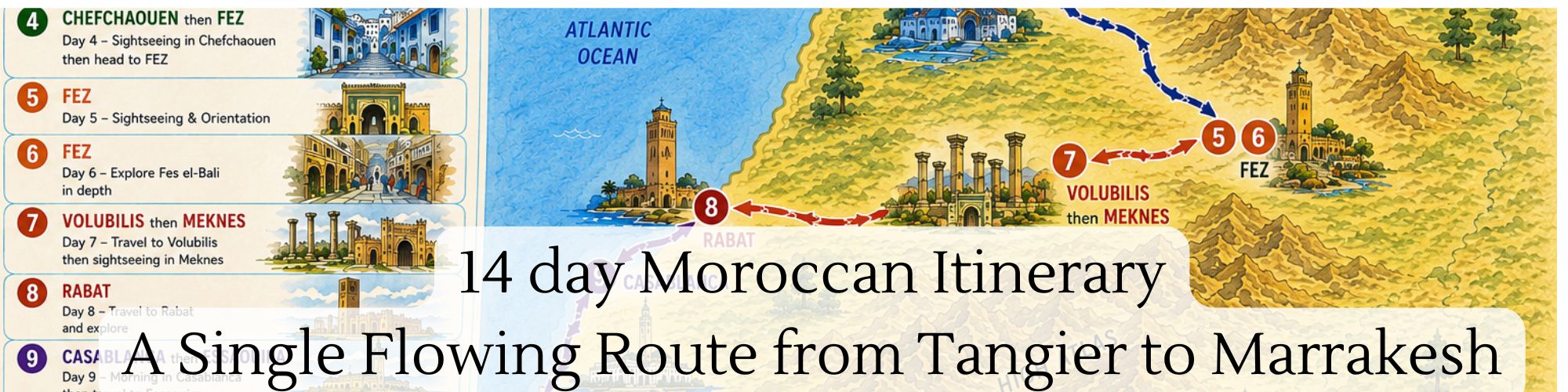
Two Weeks in Morocco A Single Flowing Route from Tangier to Marrakesh
Morocco is a big country, roughly the size of France. Two weeks is the minimum time in which to see both the North and the South of the country, in which the different regions, north and south, mountain and desert, Atlantic and Mediterranean, start to connect into a single country.
This itinerary runs from Tangier in the north to Marrakesh in the south, covering the imperial cities of the north, the Atlantic coast, the crossing of the High Atlas, the pre-Saharan landscape of kasbahs and palm oases, and the great red city that gives the country its English name. It is not an exhaustive tour of Morocco. It is a journey with a shape and a logic, designed to leave you with a genuine understanding of the country
Fly into Tangier or Casablanca, or better still catch the ferry from Spain. Fly out of Marrakesh.
Let me take you on a two week tour through the heartlands of Morocco.

Three Weeks in Morocco – The Full Arc — Imperial Cities, Atlantic Coast, High Atlas & Desert Edge
Three weeks allows you time to explore. You can give the great cities the time they deserve, reach places that the shorter itineraries cannot accommodate, and venture off the beaten track.
This itinerary follows our two-week itinerary but extends significantly into the south and east — adding the Draa Valley, Ouarzazate and the edge of the Sahara — and includes several off-piste additions that most visitors to Morocco never encounter.
Fly into Tangier or Casablanca, or better still catch the ferry from Spain. Fly out of Marrakesh.

A Month in Morocco – The Complete Journey — From the Mediterranean to the Sahara
A month in Morocco is a luxury — and a luxury worth taking if you can. In a month you can really get to know the country, you can scratch beneath the surface and get to those places where tourists rarely tread: the Mediterranean coast east of Tétouan, the Middle Atlas lakes and cedar forests, the Anti-Atlas fossil fields, the remote kasbahs of the Dades gorge & the Merzouga dunes at the edge of the Algerian Sahara.
This four-week itinerary begins in Tangiers, visits the Mediterranean east coast, the Rif mountains, the four imperial cities, the modern coastal cities, before heading down to Essaouira, then Marrakesh before heading inland and into the Middle Atlas before reaching the edge of the Great Sahara Desert. It ends back in Marrakesh, as all Moroccan journeys should.
Fly into Tangier or Casablanca, or better still catch the ferry from Spain. Fly out of Marrakesh.

