


email us hello@inspirational-traveller.com


Casablanca - Morroco's largest city & port
The first thing to say about Casablanca is that it has nothing to do with the film. Humphrey Bogart was never here. Rick’s Café is a reconstruction built in 2004 by an American diplomat who had always wanted to run a bar. The film was shot entirely in Hollywood, and the director Michael Curtiz never visited Morocco. The city’s global name recognition comes entirely from a work of fiction, and the actual Casablanca — Morocco’s largest city, its economic capital, its primary port, the home of a third of its industrial output — is a very different proposition from the cinematic version.
Which is not to say it is uninteresting. Casablanca is the most modern city in Morocco, the most economically significant, and in some ways the most revealing. It is where the country’s ambitions for the twenty-first century are most legibly written — in the new financial district, in the port developments, in the ambitious urban renewal projects. It is also where the contradictions of modern Morocco are most visible: extreme wealth and significant poverty in proximity, a young population caught between tradition and modernity, a city that has grown faster than its infrastructure can comfortably contain.
Let me guide you around the real Casablanca!
White House by the Sea
Casablanca — Casa Blanca, white house — was a small Moroccan fishing village called Anfa when the Portuguese destroyed it in 1468. It was rebuilt, destroyed again, rebuilt again, and by the eighteenth century had developed into a trading port of modest but growing importance. The Spanish briefly controlled it. The French, landing in 1907 in response to the killing of workers on a new port development, occupied it and made it the centre of their Moroccan economic operation.
Under the French Protectorate, Casablanca was transformed from a port town of thirty thousand people into the economic capital of North Africa. The French urban planner Henri Prost — the same man who designed Rabat’s ville nouvelle — planned the city on a scale appropriate to its ambitions: wide boulevards, monumental public buildings, a new port of genuine scale. By the time of independence in 1956, Casablanca had over a million inhabitants. Today it has nearly four million in the city proper and closer to six million in the greater metropolitan area.
This growth has produced a city of extreme contrasts. The Art Deco architecture of the city centre — the greatest concentration of Art Deco outside Miami — is extraordinary: buildings from the 1920s, 30s and 40s in a style that combined European modernism with Moroccan decorative elements in a way unique to this city and this period. Many of these buildings are in poor condition, their owners unable or unwilling to maintain them. Others have been renovated to a standard that makes them among the finest Art Deco survivals anywhere in the world.
It is worth spending one or two nights in Casablanca, to see the modern Morocco.
As one of the only mosques in Morocco it is definitely worth visiting the Hassan II mosque. The Art Deco district is also an interesting place for a walk.
Casablanca is also a place to eat well — the seafood restaurants along the Corniche are excellent.

The Hassan II Mosque
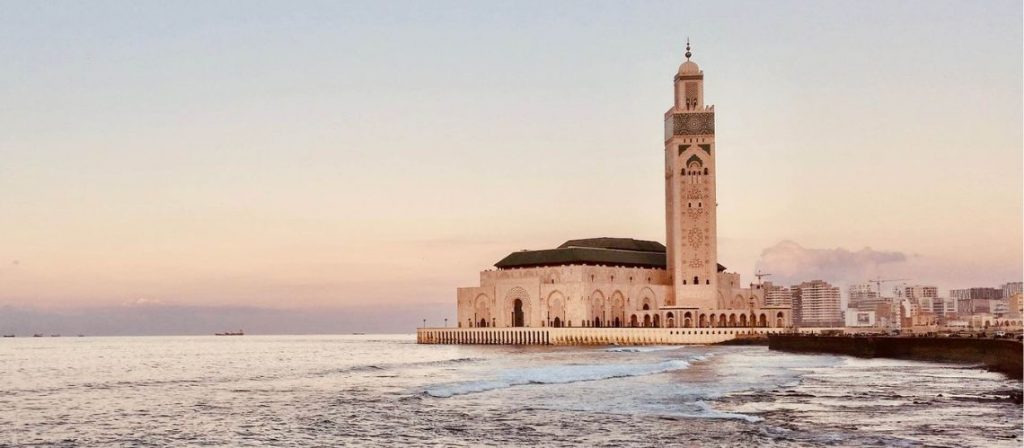
The Hassan II Mosque is the largest mosque in Africa and the fifth largest in the world. Completed in 1993 at a cost of somewhere between six hundred million and one billion dollars — financed largely by public subscription from Moroccan citizens — it stands on a promontory above the Atlantic, its great minaret rising 210 metres above the sea. At night, a laser beam from the top of the minaret points toward Mecca.
The scale of the building is genuinely staggering. It can accommodate twenty-five thousand worshippers inside and a further eighty thousand on the esplanade. The prayer hall’s retractable roof opens to the sky. The floor is of Moroccan marble and the columns are of polished granite. The carved cedarwood, the zellige tilework, the wrought iron and the painted stucco are the work of craftsmen from across Morocco, and the total area of crafted surface is immense.
It is one of the few mosques in Morocco open to non-Muslim visitors, and it should be visited on a guided tour rather than independently — both because the interior is genuinely too large to absorb without guidance and because the tour includes access to areas, including the ritual ablutions hall, that are not otherwise visible. The guided tours run several times daily.
Practical: Tours of the Hassan II mosque run at 9am, 10am, 11am and 2pm most days, though not on Fridays. Book in advance in peak season. The combination of the mosque and the seafront corniche below it makes for a good half-morning.
Art Deco and the Medina
The Art Deco architecture of Casablanca’s city centre is one of the most underappreciated urban heritage assets in Africa. The buildings of the 1920s to 40s — designed by French architects working in a deliberately hybrid Mauresque-Deco style — combine the clean lines and geometric ornament of European modernism with Moroccan arches, zellige details and carved stucco in a way that is entirely of its place and time.
The Place Mohammed V is the civic heart of this architecture: the law courts, the French consulate, the post office and the prefecture arranged around a fountain and gardens in a formal composition that still functions as the administrative centre of the city. The Boulevard Mohammed V running north from the square is the commercial spine, lined with buildings that alternate between the extraordinary and the merely handsome.
The old medina, while smaller and less architecturally significant than those of the imperial cities, has a genuine character and is being carefully restored. It is small enough to explore in an hour and its proximity to the Hassan II mosque and the port makes it a natural stop on a walking itinerary of the city. The Habous quarter — a new medina built by the French in the 1930s in a deliberately traditional Moroccan style — is also worth a walk: it is an interesting example of colonial nostalgia being used to create something that has itself become authentically old.
The Corniche and the Coast
Casablanca’s Atlantic coastline, stretching south from the Hassan II mosque along the Corniche de Aïn Diab, is the city’s leisure zone: beach clubs, restaurants, cafes, the Parc de la Ligue Arabe, and the Atlantic itself, which is cold enough year-round to be refreshing and dramatic enough even in summer to be impressive. The beach clubs — private, membership-based — are where wealthy Casablancans spend their summer weekends, but the public beach at Aïn Diab is accessible to everyone and gives a view of the city from the sea that is one of its better perspectives.
Rick’s Café — the reconstruction — is on the edge of the old medina, close to the port. It is well done, better than it has any right to be, and serves reasonable food in a convincing Moroccan setting. Go if you are curious or if irony is your mode. Skip it if you are looking for authenticity. It is the one genuinely tourist-facing experience in a city that otherwise does not orient itself around visitors.
A Working City
The most important thing to understand about Casablanca is that it is not, primarily, a tourist destination. It is Morocco’s working capital, the city where the money is made and spent, where the factories are, where the port handles the trade. The energy is different from the imperial cities — faster, less deferential, more like a contemporary metropolitan economy and less like a living museum.
This makes it interesting in different ways from Fez or Marrakesh. The restaurants of the city centre are among the best in Morocco — not the most traditional, but the most technically accomplished, reflecting a population that has money and sophisticated taste. The jazz and contemporary music scene is the most developed in the country. The gallery culture, the film culture, the literary scene: all of them more active here than anywhere else in Morocco.

Casablanca features in our two, three and four week itineraries.
Our itineraries are guides to how I would spend a week, or more touring Morocco, trying to see as much as is possible in the time you have available. The travelling is part of the experience, I always want to see as much as possible without the actual travelling becoming a chore. Sometimes I think you discover more about a country by spending a few days in one place rather than racing around trying to tick of as many sights as possible.
One World is Enough
I’m Peter , the founder of the Inspirational Traveller. I set up One World is Enough 30 years ago after spending a year travelling around Asia in the mid 90’s. On my travels I met lots of talented artisans making the most amazing things, they just needed a market for them in the West.
So I started working with them, firstly through selling on market stalls and music festival stalls. This soon grew into a shop and then a bigger shop, then an online business. Now we send One World is Enough’s collection of fair trade clothes and crafts around the World.
We design and source all our products from our own network of fair trade producers.
We produce our own range of beautiful vibrant fair trade clothes and crafts for beautiful vibrant people!
We do this by working with our own team of lovely small scale producers in India, Nepal, Indonesia, Thailand, Laos, Morocco & Afghanistan.
All our designs are made in short runs, and when they’re gone, they’re gone!
The Inspirational Traveller
People kept asking about my travels to some of the more unusual, off the beaten track destinations that I travelled to. So I set up the Inspirational Traveller, as a curated travel guide.
I write these guides and itineraries, when I have the time, so it is a bit of a slow process, but I am adding more and more content, as I get the time.
The Inspirational Traveller is designed to a curated travel guide, to inspire you about places to visit, rather than be an exhaustive guide.
Hope you enjoy it!

 |  |  |  |