


email us hello@inspirational-traveller.com


Essaouira - Beautiful Fishing Port on the Atlantic Coast
There is a particular quality to the light in Essaouira that I have not found elsewhere in Morocco. It is an Atlantic light — bright but softened by the moisture in the air, bounced off whitewashed walls and the surface of the sea — that makes the city’s colours (white, blue, the rust of the rampart walls, the vivid paint of the fishing boats) seem almost artificially intense. Combined with the constant wind off the ocean, which keeps the temperature bearable even in July, and the sound of the sea audible from almost everywhere in the medina, it creates an atmosphere that is recognisably Moroccan and yet unlike any other Moroccan city.
I first came to Essaouira in 1997 on the recommendation of an artisan in Marrakesh who told me I would find better quality woodwork here than anywhere else in Morocco. He was right. I also found a city of unusual beauty and an unusual temperament — relaxed by Moroccan standards, creative in a way that was real rather than performed, and possessed of a history as layered and strange as anything in the imperial cities. I have been back many times.
In fact every time I visit Marrakesh I make the three hours bus journey to Essaouira to spend a few days just unwinding and enjoying the simple pleasures of being beside the sea

Mogador: The Atlantic Trading Port
Essaouira spent most of its history as Mogador, a name of disputed etymology — Amazigh, Hebrew and Phoenician origins have all been argued. The Phoenicians established a trading post here in the seventh century BC. The Romans used the islands offshore to produce Tyrian purple, the expensive dye made from sea snails that coloured the robes of emperors and senators. The name Essaouira — ‘the beautifully designed’ in Arabic — is relatively modern, adopted after independence.
The modern city was substantially rebuilt in 1765 by Sultan Mohammed III, who wanted to create a proper Atlantic port to control Morocco’s foreign trade. He employed a French architect — Théodore Cornut, a student of Vauban — to design the fortifications, and the result is a medina of unusual regularity by Moroccan standards: a street plan derived from European military urbanism, overlaid with Moroccan domestic architecture and commercial life. The combination gives Essaouira its characteristic quality of ordered complexity.
As a trading port, Essaouira occupied a unique commercial position. The sultan established it as the sole legal point of trade between Morocco and the European powers, and Jewish merchants — particularly the Sephardic community that had been in Morocco since the expulsion from Spain in 1492 — became the commercial intermediaries between the Moroccan interior and the European trading companies. The city’s mellah — its Jewish quarter — was one of the largest and most prosperous in Morocco, and the Jewish community at its peak in the nineteenth century represented nearly half the city’s population.

The Medina and the Ramparts
The medina of Essaouira is a UNESCO World Heritage Site, and it is more immediately navigable than most Moroccan medinas because its street plan — that French-derived grid — gives it an internal logic that Fez or Marrakesh do not have. You can be lost in Essaouira, but you can find your way out more easily. The main commercial artery, the Rue Mohammed el-Qory, runs through the centre of the medina from north to south; parallel streets either side of it contain the craft workshops, galleries, restaurants and residences that make up the fabric of the city.
The skala — the sea bastion — is the most dramatic feature of the fortifications. A broad rampart walkway runs above a battery of sixteenth-century bronze cannons pointing permanently at the Atlantic, and the wind along it, even on a calm day, is considerable. The view from the ramparts takes in the harbour below, the offshore islands (the Îles Purpuraires, where the Romans made their purple dye), and the Atlantic stretching to the horizon. At the far end of the walkway, a collection of woodworking workshops occupies the ground-floor chambers of the bastion: marquetry and carved furniture made from thuya wood, the fragrant resinous local hardwood that is one of Essaouira’s particular crafts.
Buy with care: The thuya woodwork sold in the tourist shops varies enormously in quality. The best pieces — intricate marquetry boxes, carved frames, furniture — are made by artisans working in workshops you can watch in operation. Ask to see the workshop before buying; the process tells you a great deal about the quality of the result.
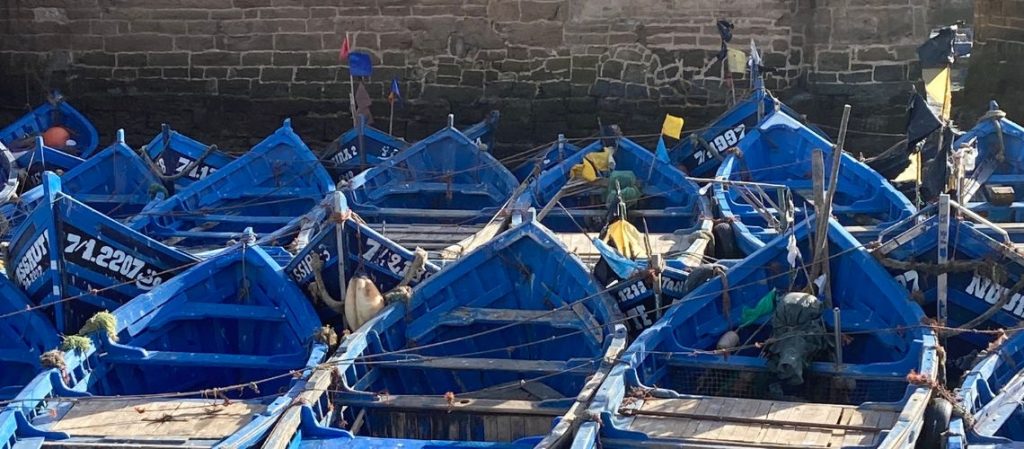
The Port and the Fishing Harbour
The working fishing harbour at the southern end of the medina is one of the most photogenic and genuinely functioning ports in Morocco. The blue wooden boats — the distinctive Essaouira blue that appears on shutters and doors throughout the medina — are ranked along the quay each morning when they return with the night’s catch. The fish market operates adjacent to the harbour, and the smell of fresh catch and salt water is immediate and completely real.
Along the quay, fish stalls grill the day’s catch over charcoal. The protocol is simple: choose your fish or seafood from the display, agree on a price, and it is grilled and served on a tin plate with bread and harissa. The prawns and sardines are consistently excellent. The calamari varies. Arrive before midday for the best selection. This is the most honest, most pleasurable and least expensive eating experience in Essaouira.
The port is also where the boat-builders work. Watching a traditional wooden fishing boat being built — plank by plank, using techniques that have not fundamentally changed in centuries — is fascinating.
Orson Welles and Jimi Hendrix — The Artistic Inheritance
Orson Welles came to Essaouira in 1949 to film Othello. He ran out of money during production and spent years returning to complete it, funding each section from his acting work in other people’s films. While he waited for money and costumes to arrive from Hollywood, he filmed the murder of Roderigo in a public bathhouse in the medina, using his actors in towels because the costumes had not arrived. The resulting scene is one of the most inventive pieces of location filmmaking in cinema history, born entirely of necessity. A bronze statue of Welles now stands near the port.
Jimi Hendrix arrived in 1969 and stayed, according to various accounts, for between a few days and several weeks. The exact house he slept in is claimed by several establishments in the medina, none of which can be verified. What is documented is that he was here, that he loved the city, and that the Gnawa musicians he encountered here — performing their trance music in the squares and cafes — influenced his subsequent work. Whether the influence is audible in his late recordings is a question for music scholars. What is certain is that Essaouira has been attracting musicians and artists ever since.
The Gnawa World Music Festival, held annually in June, brings together Gnawa musicians from across Morocco with international artists for a four-day festival in the squares, ramparts and concert venues of the city. It is one of the most interesting music festivals in Africa — genuinely rooted in a local tradition of extraordinary depth, but open to the world in a way that has produced remarkable collaborations.
Wind and the Art of Doing Nothing
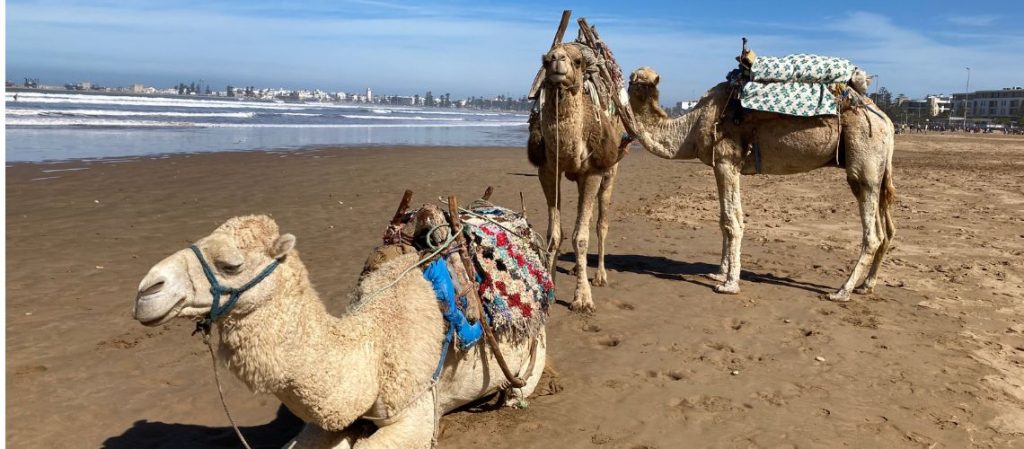
The Alizé — the trade wind that blows off the Atlantic almost every afternoon — has made Essaouira’s beaches some of the finest in Africa for wind and kite surfing. The beach to the south of the medina extends for several kilometres, wide and flat and reliably windy, and the infrastructure for water sports is well developed. But the wind also makes the beach, in the afternoons, somewhat challenging for ordinary sunbathing; the sand is carried horizontally and gets into everything.
The morning, before the wind rises, is the best time for the beach. The water is cold by Mediterranean standards — the Atlantic currents that run along this coast are genuinely cold even in summer — but perfectly swimmable. The light in the morning is the famous Essaouira light, and the beach stretching empty in both directions, the city walls behind you and the ocean ahead, is one of the more beautiful morning views in Morocco.
I would recommend spending at least three days in Essaouira. The medina and port for the first day, the ramparts and the art galleries for the second — the gallery culture here is the best in Morocco outside the major cities —and a walk across the long sandy beach to Diabat for the third.
It is also the perfect place in Morocco to just unwind and relax and recharge after spending time in the cities.
One World is Enough
I’m Peter , the founder of the Inspirational Traveller. I set up One World is Enough 30 years ago after spending a year travelling around Asia in the mid 90’s. On my travels I met lots of talented artisans making the most amazing things, they just needed a market for them in the West.
So I started working with them, firstly through selling on market stalls and music festival stalls. This soon grew into a shop and then a bigger shop, then an online business. Now we send One World is Enough’s collection of fair trade clothes and crafts around the World.
We design and source all our products from our own network of fair trade producers.
We produce our own range of beautiful vibrant fair trade clothes and crafts for beautiful vibrant people!
We do this by working with our own team of lovely small scale producers in India, Nepal, Indonesia, Thailand, Laos, Morocco & Afghanistan.
All our designs are made in short runs, and when they’re gone, they’re gone!
The Inspirational Traveller
People kept asking about my travels to some of the more unusual, off the beaten track destinations that I travelled to. So I set up the Inspirational Traveller, as a curated travel guide.
I write these guides and itineraries, when I have the time, so it is a bit of a slow process, but I am adding more and more content, as I get the time.
The Inspirational Traveller is designed to a curated travel guide, to inspire you about places to visit, rather than be an exhaustive guide.
Hope you enjoy it!
