


Merzouga & The Sahara- The Edge of the Desert — Where the Dunes Begin
The Sahara is not a destination you arrive at in the ordinary sense. You travel toward it for hours through landscapes that change gradually to become more arid, more open, more otherworldly — the Atlas behind you, the vegetation thinning, the palette narrowing to ochre and sand and pale blue sky — and then the dunes appear on the horizon and you understand that the journey has been, part of teh experience.
Merzouga is a small desert town on the northwestern edge of Erg Chebbi, the great sand-dune field that is Morocco’s most dramatic piece of Saharan landscape.
I have been here several times, in different seasons, and the effect of the dunes has never diminished — everytime I see them they look different, because the dunes themselves change with the light and the season and the wind in ways that make each visit genuinely different.
Erg Chebbi: The Dunes
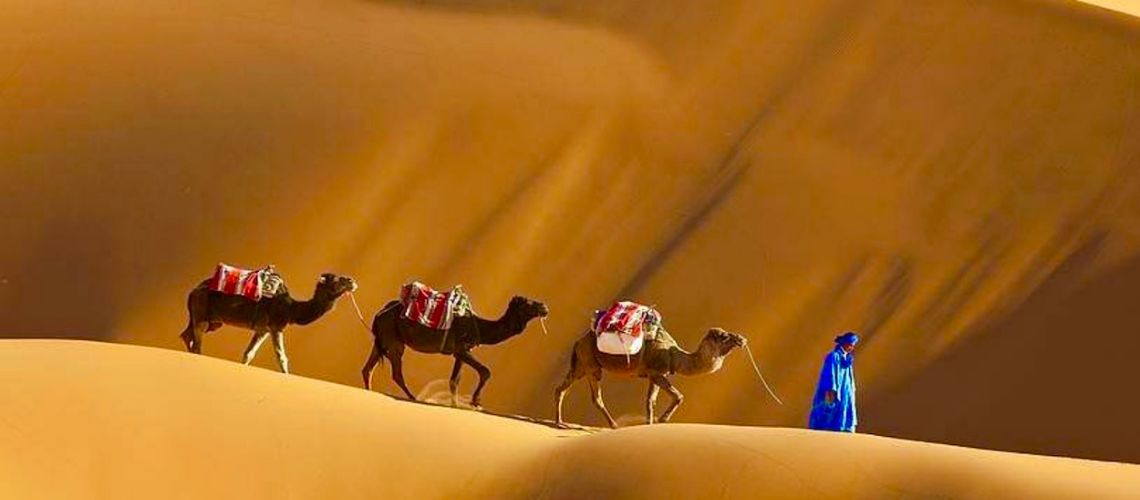
Erg Chebbi is a sand sea of approximately fifty square kilometres, with dunes rising to between one hundred and one hundred and fifty metres at their highest. By Saharan standards — the great ergs of Algeria or Mauritania cover thousands of square kilometres — it is modest in scale. By any standard an outsider is likely to have encountered, it is extraordinary.
The dunes are not static. They move with the wind — slowly, measurably, decade by decade — and their shapes change constantly with the direction and force of the wind on any given day. The colour of the sand changes with the light: pale gold at midday, deep orange in the afternoon, rose-red at sunset, a surprising violet-grey at dawn before the sun appears. The finest experience of the dunes is at these transitional moments — dawn and dusk — when the raking light reveals the form of each dune in sharp relief and the colours are at their most extreme.
The silence of the dunes at night is one of the most complete silences available on earth. Outside the tourist season, when the generator noise of the desert camps has stopped and the wind has dropped, you can lie on the sand and hear absolutely nothing. The stars, at this altitude (about nine hundred metres) and in this absence of light pollution, are amazing, a cosmic lightshow, rather than the partial version most people see from their gardens or cities. Neither experience — the silence or the stars — can be adequately described. Both are well worth making the effort to get here.
Getting There: The Journey as Part of the Experience
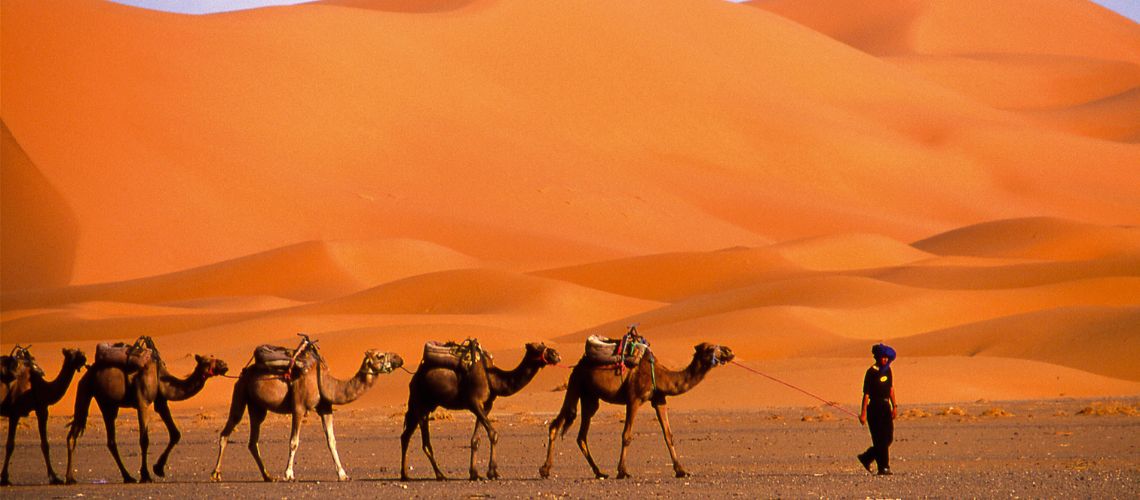
Merzouga is accessible from several directions, each of which constitutes a significant journey in itself. The most common route is from Ouarzazate or Boulmane-Dades via the Todra and Dades gorges — a two-day drive through landscapes of such consistent drama that the dunes, when they finally appear, feel like the culmination of an epic expedition..
The Todra Gorge, about halfway along this route, is a vertical-walled canyon of rose-red limestone, the walls rising three hundred metres above the river that carved them. The gorge is walkable for several kilometres, the path running beside the river under walls that narrow to ten metres at the canyon’s tightest point. The light inside the gorge at mid-morning — shafts of sun reaching the river floor through a gap barely wider than the sky — is a different kind of extraordinary from the open landscape around it.
The Dades Gorge, to the west of Todra, is longer and more varied, its pink and red rock formations given a quality somewhere between natural and sculpted by the erosion of millennia. The road through it climbs to a plateau with views of the High Atlas that, in winter, are snow-covered and in spring are green in a way that the desert approaches do not prepare you for.
The Desert Camps
The infrastructure around Merzouga and Erg Chebbi has developed significantly over the past two decades, and the range of desert camp experiences available now extends from basic tented accommodation with a blanket and a candle to ‘luxury’ camps with private tents, en-suite facilities and gourmet dinners cooked in the desert. The latter are more comfortable. The former are more authentic.
My advice is to choose a camp that gets you furthest into the dunes and furthest from the road. The authentic experience of the Sahara is not compatible with proximity to a generator or a road. The best camps are an hour’s walk (or camel ride) from the edge of the erg, which puts them far enough from the town that the silence is real and the light on the dunes uninterrupted by any artificial source. Once you have chosen to come this far, it is worth going far enough to get the untainted experience .
Timing: October to April are the best months. Summer temperatures exceed 45°C and the experience, while still visually extraordinary, is physically challenging. Winter nights in the dunes are genuinely cold — below freezing is possible — which is something camps do not always emphasise and visitors do not always anticipate. If you are coming in Winter please remember to pack accordingly.
.
The Gnawa of Khamlia
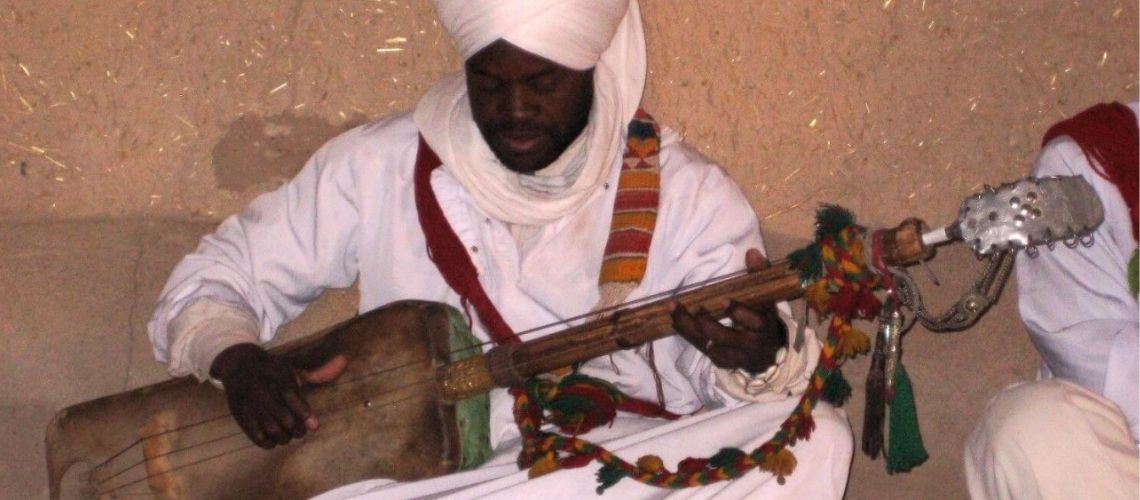
Three kilometres from Merzouga, the village of Khamlia is inhabited by a community descended from the sub-Saharan Africans brought to Morocco as slaves in the sixteenth and seventeenth centuries — the same community whose music, can often be heard at night in the squares of Marrakesh. In Khamlia, the Gnawa music is not a tourist performance; it is a living spiritual tradition, practised in the context of healing ceremonies (the lila) that use music and trance to address illness and spiritual crisis.
Several families in Khamlia receive visitors and perform something of the Gnawa tradition for them — the music, the instruments (guembri bass lute, qraqeb metal castanets), the call-and-response structure. This is, inevitably, a bit of an experince laisd on for the tourists: a healing ceremony is not a concert, and what you see in the visitor context is not the full spiritual practice. But the music itself — cyclical, hypnotic, of extraordinary rhythmic power — is genuinely moving even in this form, and the community’s willingness to share it with outsiders helps support their culture and way of life and therefore I believe it is worth supporting.
The Fossils of the Kem Kem
The region around Merzouga and the desert to the east contains one of the richest fossil beds in the world. The Kem Kem formation — a sequence of Cretaceous rocks exposed by erosion — has produced dinosaur remains, ancient fish and marine reptiles of considerable scientific significance. Roadside stalls throughout the region sell fossils of varying quality and legality: trilobites, ammonites, orthoceras — ancient nautiloids — and occasional dinosaur bone fragments.
The trilobites in particular are extraordinary — some specimens are preserved in three dimensions with a clarity that makes them look like they might be alive. The ethics of purchasing fossils are complicated — commercial fossil extraction can damage scientific sites, and the legal status of export varies — but the roadside trade in common specimens has been a part of the local economy for generations, and the trilobites and ammonites are sufficiently abundant that personal purchase of small specimens is unlikely to damage the scientific heritage significantly, but does support the local economy. Use your judgment and do not buy anything that looks like it might be a significant specimen.
The Sahara, at Merzouga, is the authentic desrt experience, it is not necessarily a comfortable experience and is not meant to be. The discomfort — the heat, the cold, the sand, the silence, the distance from anything familiar — is part of what makes it special
Merzouga and the Sahara is a unique experience that will stay with you forever. I have never met anyone who came here and felt the journey was not worth it. And how often can you say that?.
One World is Enough
I’m Peter , the founder of the Inspirational Traveller. I set up One World is Enough 30 years ago after spending a year travelling around Asia in the mid 90’s. On my travels I met lots of talented artisans making the most amazing things, they just needed a market for them in the West.
So I started working with them, firstly through selling on market stalls and music festival stalls. This soon grew into a shop and then a bigger shop, then an online business. Now we send One World is Enough’s collection of fair trade clothes and crafts around the World.
We design and source all our products from our own network of fair trade producers.
We produce our own range of beautiful vibrant fair trade clothes and crafts for beautiful vibrant people!
We do this by working with our own team of lovely small scale producers in India, Nepal, Indonesia, Thailand, Laos, Morocco & Afghanistan.
All our designs are made in short runs, and when they’re gone, they’re gone!
The Inspirational Traveller
People kept asking about my travels to some of the more unusual, off the beaten track destinations that I travelled to. So I set up the Inspirational Traveller, as a curated travel guide.
I write these guides and itineraries, when I have the time, so it is a bit of a slow process, but I am adding more and more content, as I get the time.
The Inspirational Traveller is designed to a curated travel guide, to inspire you about places to visit, rather than be an exhaustive guide.
Hope you enjoy it!
