


email us hello@inspirational-traveller.com


Taroudant: - Little Marrakesh without the tourists
Taroudant is the city I recommend to people who ask me where in Morocco they should go to get away from the tourist circuit without actually leaving Morocco’s best landscapes and history. It is the city I would go to if I wanted to spend a week reading and eating well and walking in medina lanes where I was not the most unusual thing in them. It is, in the quietly genuine sense, a secret — but one that I am sharing with you.
The official nickname — Little Marrakesh — refers to its walls and its setting, both of which are similar in palette and atmosphere to the more famous city to its north. The comparison is fair in those limited respects and misleading in all others. Taroudant is quieter, more local, more authentic. Its souks are working markets. Its cafes are for the residents rather than the visitors. Its pace is the pace of a southern Moroccan market town that happens to have extraordinary walls and an interesting history, not the pace of a city orienting itself around an international tourist economy.
If you have an extra day or two, I would spend it here, both in the city and in the beautiful surrounding countryside..
The Saadian Capital
Taroudant sits in the Souss valley, in the plain between the High Atlas to the north and the Anti-Atlas to the south, watered by the Souss River and surrounded by agricultural land of unusual fertility. It has been inhabited since antiquity, and its strategic position — controlling the routes between the Sahara and the Atlantic coast, between the mountains and the sea — made it significant throughout Morocco’s dynastic history.
Its moment of greatest importance came in the sixteenth century, when it served as the first capital of the Saadian dynasty. The Saadians were a sharifian — descended from the Prophet — dynasty from the Draa valley to the south who rose to power partly on their religious prestige and partly on their control of the trans-Saharan gold and slave trade. From Taroudant, they launched the campaigns that would eventually take Marrakesh and then Fez, making them masters of all Morocco. The city’s role as a capital was brief — the Saadians moved their seat of power north once they controlled the whole country — but the walls they built around it have endured.
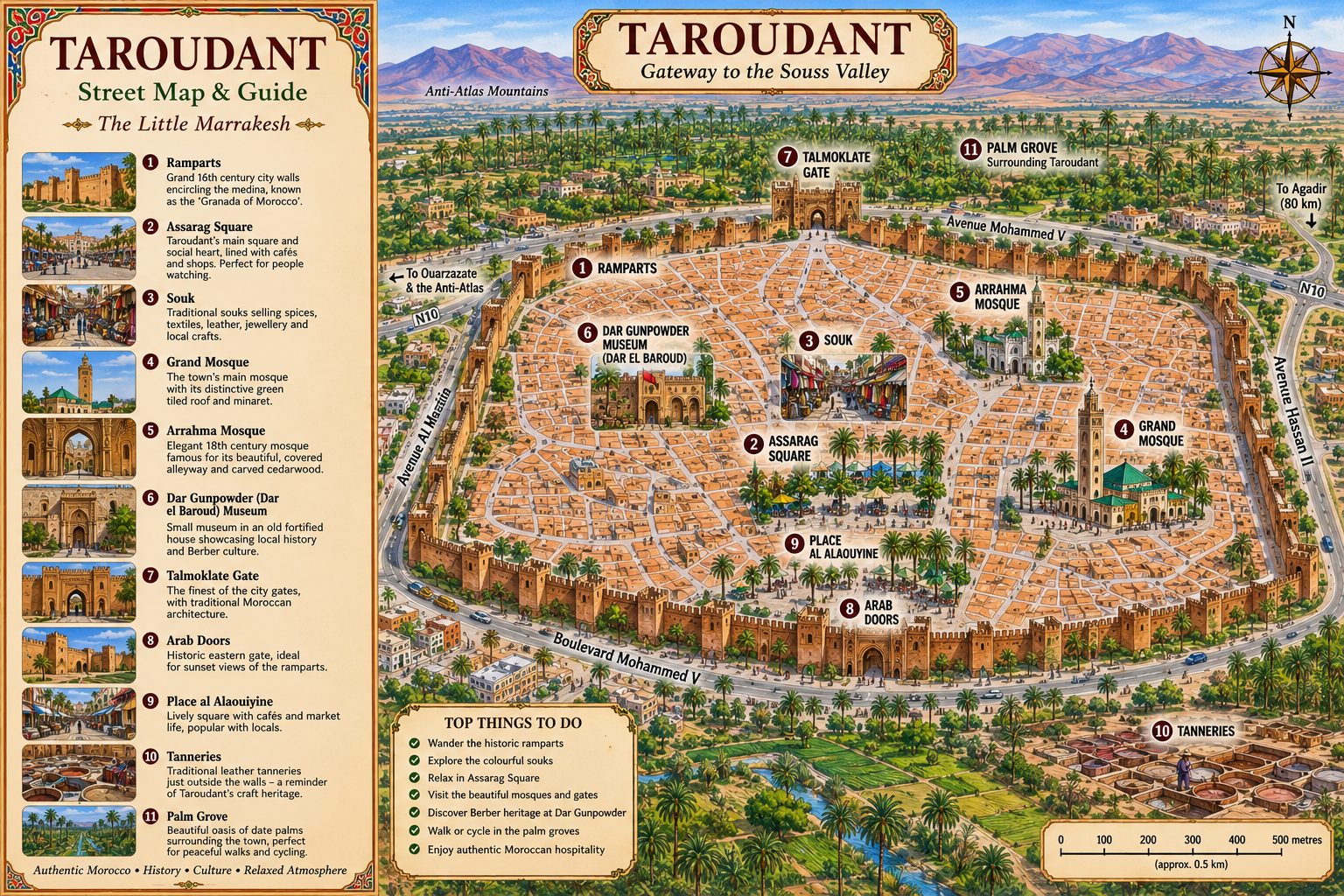
Those walls — the great ramparts that enclose the old city — are the first thing you see and the thing that stays with you. Built of pisé, the rammed earth and lime mixture that is the traditional building material of southern Morocco, they stand seven to ten metres high and run for seven kilometres around the city, punctuated by towers and gates. In the evening light, the pisé turns from pale ochre to a deep rose-gold that is different from the walls of any other city I have visited. Walking the full circuit of the ramparts takes about two hours and offers, in the gaps between the more modern development that has grown up outside the walls, views of the Souss valley and the mountains that are as fine as anything in Morocco.

The Medina: Local, Unhurried, Genuine
Inside the walls, Taroudant’s medina has two distinct souks — the Berber market and the Arab market — that reflect the city’s mixed cultural heritage. The Berber market, to the north of the main square, is the older and in many ways the more interesting: a network of covered lanes where jewellers, herbalists, fabric merchants and spice traders work in a tradition that has been continuous here for centuries.
The jewellery of Taroudant and the Souss valley is among the most distinctive in Morocco. The Amazigh women of the region have a jewellery tradition — heavy silver pieces, amber, coral and enamel, in forms specific to each tribe and valley — that is significantly different from the jewellery you find in the northern cities. The best pieces are in the hands of dealers who understand what they have; the souk contains a range from genuine antiques to recent production of variable quality, and the ability to tell the difference is worth developing before you buy.
The Arab market, centred around the Place Assarag, has a more commercial character and contains the kind of goods — leather, pottery, textiles — that you find in the tourist medinas of Marrakesh or Fez, but sold at prices that reflect local rather than tourist commerce. The leather goods in particular are good value: the Souss valley has its own leather-working tradition, and the quality of the finished products is high.
Market days: Taroudant has twice-weekly markets — Thursday and Sunday — when the surrounding rural population comes to town to sell produce and buy goods. These are the best days to experience the city’s commercial culture in its most genuine form.
The Walls at Evening
The single experience in Taroudant that I would not miss is walking the circuit of the ramparts at dusk. The light on the pisé walls in the hour before sunset is extraordinary — the colour shifts from pale sand through ochre to a deep terracotta that makes the walls glow as if from within. The city spreads below you on the inside: minarets, orange trees in courtyards, the smoke from cooking fires. The Souss valley extends to the south, and the High Atlas fills the northern horizon, the peaks white in winter and pale rock in summer.
This is a walk that can be done on foot along the base of the walls or, more dramatically, on horseback — the stables near the main gate offer horses and guides for the circumference, which takes about ninety minutes at a walking pace. The horse option is not a tourist gimmick. It is the most useful way to cover the distance comfortably and gives a perspective that you simply cannot get on foot.
Beyond the Walls: the Souss and the Anti-Atlas
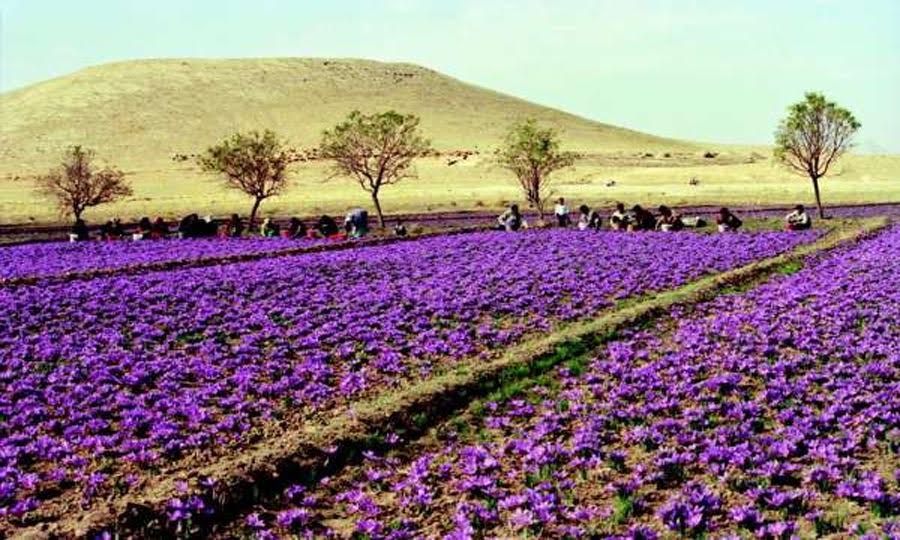
Taroudant is the ideal base for exploring southern Morocco beyond the standard tourist circuit. The saffron fields around Taliouine, two hours east on the road to Ouarzazate, are the largest in Morocco and produce a significant percentage of the world’s finest saffron. The harvest period in October and November — when the purple crocus flowers are picked at dawn before the petals open fully, and the entire plain is the colour of the flowers — is one of the most extraordinary seasonal spectacles in Morocco. Visit at any time and the landscape of the Taliouine valley, surrounded by the Sirwa massif, is exceptional.
The Anti-Atlas to the south of the city, accessible by road through a landscape of argania and red rock, contains some of the oldest fossil sites in Morocco — trilobites and ammonites, extraordinarily preserved, that you can buy from roadside dealers or, better, find for yourself in the geological exposures of the hillsides. Tafraout and the surrounding villages are another forty minutes south and worth a night if you have the time.

Where to Stay
The Palais Salam is the classic choice: a converted pasha’s palace from the Protectorate period, set within the ramparts, with gardens, a pool, and a dining room of genuine quality. It is not a cheap option, but is a very romantic option if you fancy splashing out. The smaller riads within the medina offer a more intimate and less expensive alternative; the quality varies considerably, and it is worth choosing based on reviews rather than price.
I would recommend three nights as being about right for Taroudant. Use them to walk the medina, circumnavigate the walls, eat well in the riad restaurants and the medina cafes, drive into the Anti-Atlas for an afternoon, and sit in the main square in the evening watching the city go about its business.
It is one of the most genuinely restorative places I know in Morocco, it is the hidden Morocco, it is as you imagine Marrakesh might have been like before the hordes of tourists descended
One World is Enough
I’m Peter , the founder of the Inspirational Traveller. I set up One World is Enough 30 years ago after spending a year travelling around Asia in the mid 90’s. On my travels I met lots of talented artisans making the most amazing things, they just needed a market for them in the West.
So I started working with them, firstly through selling on market stalls and music festival stalls. This soon grew into a shop and then a bigger shop, then an online business. Now we send One World is Enough’s collection of fair trade clothes and crafts around the World.
We design and source all our products from our own network of fair trade producers.
We produce our own range of beautiful vibrant fair trade clothes and crafts for beautiful vibrant people!
We do this by working with our own team of lovely small scale producers in India, Nepal, Indonesia, Thailand, Laos, Morocco & Afghanistan.
All our designs are made in short runs, and when they’re gone, they’re gone!
The Inspirational Traveller
People kept asking about my travels to some of the more unusual, off the beaten track destinations that I travelled to. So I set up the Inspirational Traveller, as a curated travel guide.
I write these guides and itineraries, when I have the time, so it is a bit of a slow process, but I am adding more and more content, as I get the time.
The Inspirational Traveller is designed to a curated travel guide, to inspire you about places to visit, rather than be an exhaustive guide.
Hope you enjoy it!
