


email us hello@inspirational-traveller.com


Marrakesh - The iconic Red City
Marrakesh is a bewildering assault on all your senses, all at the same time, sometimes it can be hard to take it all in. There is a particular moment in Marrakesh — it happens to most visitors, usually on the first morning — when your senses simply give up trying to process everything at once and you are left standing in the middle of a lane in the medina, slightly bewildered, grinning despite yourself. I have had that moment more than once, and I hope I never stop having it.
In the ancient souks of Marrakesh you feel as if you are an extra in the 1001 Arabian Nights, as if you have been transported back to a time when talented artisans sold the things that they had made themselves, either on their stalls in the markets or if they couldn’t afford a stall then from a blanket on the ground. In fact it is not far from the truth. In our recent trip to Marrakesh, we discovered a whole warren of workshops in the back streets where artisans were making all nature of handmade goods, from metal lamps to furniture. We came back with a container load of Moroccan Candle Lanterns, amazing star shaped lampshades and those big hand cut lampshades with coloured glass that grace the stairwell of the ancient riads. You can read about our visit to the lantern makers here.
I first came to Marrakesh in the late 1990s, not as a tourist but looking for more artisans to join the fair trade network I was setting my for my new fair trade business One World is Enough. I have been back many times since. What I have learned, over all those visits, is that the Marrakesh most people see — the one on the travel brochures and Instagram feeds — is real enough, but it is only the surface. Beneath it is a city of extraordinary complexity, of craftsmen who have perfected their trades over generations, of a culture that has been doing business with the world for a thousand years. The hard sell in the souks is not rudeness; it is a tradition. The labyrinthine medina is not designed to confuse; it is designed to slow you down, to keep you inside it.
You can zoom in and out on the map and click on the various elements for more information.
Djemaa el-Fna: The Living Heart of Marrakesh
Every travel writer who has ever been to Marrakesh has written about Djemaa el-Fna, and most of them have failed to do it justice. The square is not just a visual experience. It is an experience of sound, smell, heat, and sustained theatrical chaos that has been running — more or less continuously — for around a thousand years.
The UNESCO designation it received in 2001 was not for any building or monument. It was for the square itself as an example of the Intangible Cultural Heritage of Humanity — the oral traditions, the storytellers, the gnawa musicians, the acrobats. It was one of the first such designations ever awarded, and it was deserved.
By day, the square is ticking over — juice sellers with their pyramids of oranges, snake charmers (more theatrical than threatening), men with Barbary macaques who will place one on your shoulder and charge you for the privilege whether you consented or not.
Have coffee on the terrace of one of the cafes overlooking the square. The Café de France and the Café Argana both have terraces that look over the square from above, and the combination of a café au lait and an elevated view of the Djemaa at nine-thirty in the morning, before the main surge of the day begins, is one of the quieter pleasures available in Marrakesh..
By dusk, the square transforms. The food stalls are assembled with practised speed. Hundreds of oil lamps and bare bulbs are lit. The smoke from a hundred grills rises into the cooling Marrakesh air. Storytellers gather their circles of listeners. The gnawa musicians — descendants of sub-Saharan slaves brought to Morocco centuries ago — begin their hypnotic, cyclical rhythms. If you speak Arabic or French you will get more from the storytellers; if you speak neither, the gnawa need no translation.
To see the square in all it’s glory I would advise you to go twice. Once at mid-morning, when you can see the square’s buildings and structure, then once at nine in the evening, when it is in full flow: a place of theatre, commerce, community and controlled mayhem. The two visits are barely recognisable as the same location.
Click here to read our Moroccan Food Guide
Practical note: The food stalls are fine to eat from — I have eaten from them many times — but check that your fish and seafood is fresh and has been cooked through. Stick to grills and tagines rather than things that have been sitting in sauces for hours. Stall number 14 has been serving excellent harira and merguez for as long as I can remember.

The Medina: Don’t Fight the Labyrinth
The medina of Marrakesh — the old walled city — is a UNESCO World Heritage Site, and it is one of the best-preserved medieval Islamic cities in the world. It is also, let us be honest, genuinely disorienting. The lanes fold back on themselves, dead ends appear without warning, and the maps bear only the most approximate relationship to what you will actually find underfoot. This is not a design flaw. It is the design.
Medieval Islamic urban planning was deliberately intimate. Wide streets invite armies and tax collectors; narrow lanes belong to residents. The medina was built to be known, not navigated. The people who live there move through it with the ease of long familiarity. You will not achieve that on a three-day visit. But you can achieve something almost as good: the willingness to be lost.
My single best piece of advice for the medina is this: put your phone in your pocket, and lose yourself for a couple of hours, and walk. Follow your nose, go which ever way looks more interesting. You will end up somewhere unexpected. Nine times in ten, somewhere unexpected in the medina is somewhere worth being.
And the great thing is that when you want to go back to your riad, you can get your phone out of your pocket and ask it to take you back. It’s not like the old days when getting completely lost in the medina was a real possibility!

The Souks
From the northern edge of the Djemaa el-Fna, the entrance to the souk district is marked by Souk Semmarine — the main artery of the commercial medina, covered with a latticed bamboo roof that filters the light into a warm orange-brown that falls on the lane below like a perpetual late afternoon. The lane is wide by medina standards and moves with a density of people — shoppers, mule-carts, tourists, delivery men with improbable loads on their backs — that is immediately disorienting and quickly navigable.
The organisation of the souks by trade is medieval in origin and largely intact. Souk Semmarine itself deals in textiles and clothing. Turn right off it and the lanes narrow into the carpet souk; left and you find the silver and jewellery quarter. Further north, the leather workers occupy a section of covered lanes where the smell of the skins is noticeable, and beyond them the dyers’ souk — a lane strung with hanks of freshly dyed wool in shades of saffron, crimson and indigo, hung between the buildings to dry. If you find the dyers’ souk — and finding it involves taking a lane that does not feel like the right lane and persisting — stop and look up. The colours against the pale walls and the strip of sky above is one of the most photogenic scenes in the medina.
Souk el-Attarine — the spice and perfume souk — runs parallel to Souk Semmarine further north. The name means the souk of the perfumers, and the combination of dried roses, cinnamon bark, cumin, oud wood and argan oil that the shops here carry produces a smell that is dense, warm and completely of Marrakesh. This is where to buy spices if you are going to buy them — better quality and more honest pricing than the tourist-facing shops near the square.
Shopping in the souks: The first price quoted is not the price. A counteroffer of roughly a third is the expected opening of the negotiation. Do not begin negotiating unless you are willing to buy; starting a price discussion and then walking away is considered poor form. If you simply want to look without pressure, say so at the outset — ‘ana ghir kantfarraj’ (I am just looking) — and move on.
Beyond the tourist souks, go looking for the working souks — the ones where the leather is being tanned, where the brass is being hammered, where the woodwork is being carved. The Chouara Tannery, visible from the terrace of neighbouring leather shops, is a good starting point. The smell is confrontational but the view — of the ancient dye vats arranged in a honeycomb of ochre, saffron, poppy red and dark indigo — is one of the genuinely extraordinary sights of the city.
Worth knowing: The mint tea offered in shops is always very sweet. If you prefer less sugar, say ‘b-shwiya s-sukkar’ — with a little sugar. You will be understood, and possibly respected for it.

The Medersa Ben Youssef
The Medersa Ben Youssef is the finest Islamic interior in Marrakesh that non-Muslims are permitted to enter, and by some measures the finest in Morocco outside Fez. Built in the sixteenth century by the Saadian sultan Abdallah al-Ghalib on the site of an earlier Merinid medersa, it served as a residential theological college — a place where students came to study at the neighbouring mosque and its associated scholarly tradition. At its height it housed around nine hundred students in tiny cells around a central courtyard.
The courtyard is the experience. The lower walls are tiled in geometric zellige to shoulder height. Above the zellige, carved stucco panels of extraordinary delicacy carry calligraphic inscriptions and geometric compositions in low relief. Above the stucco, a screen of carved cedarwood separates the courtyard from the upper galleries. At the centre, a marble basin reflects the sky and the carved surfaces above it. The proportions of the whole — the relationship between the width of the courtyard, the height of the walls, the scale of the ornament — are calibrated with a precision that rewards attention.
The small rooms around the upper gallery, where the students lived, are open to visitors. Standing in one of these — a space barely large enough to lie down in, with a tiny window onto the courtyard below — and trying to imagine studying advanced theology and jurisprudence in it, is one of the more useful exercises in historical imagination available in the medina.
Allow at least forty minutes here. The medersa is one of those places that reveals more the longer you stay. Sit in the courtyard rather than moving immediately to the upper gallery. Look at how the light changes on the stucco as clouds pass and the reflected light on the ceiling shifts.
Visit in the morning when the light falls into the courtyard from the east. The reflected light on the plasterwork creates effects that no photograph has ever adequately captured. This is one of those places where you genuinely need to be present in it — standing in the courtyard, looking up at the carved wooden screen above the prayer niche — to understand why people have been building like this for a thousand years.

The Palaces: Splendour and Its Ruins
Marrakesh was, for much of its history, a seat of imperial power. The sultans built here on a scale commensurate with their ambitions. Two palaces in particular are worth your time, and they could not be more different from each other.
The Bahia Palace
Built in the late nineteenth century for Si Moussa, grand vizier to the sultan, and then expanded by his son Ba Ahmed, the Bahia Palace is enormous — over eight hectares of interconnected courtyards, apartments, gardens and reception halls. The name means ‘brilliance’, and in places it earns it.
The painted wooden ceilings are extraordinary — dense geometric compositions in ochre, vermilion and midnight blue, with a level of craft that makes you want to stand under them for far longer than feels socially normal. The marble floors are cool underfoot even in summer. The gardens, planted with orange trees, are deeply shaded and deeply quiet.
What makes the Bahia interesting beyond its beauty is its story. Ba Ahmed built it to house his wives, concubines and children — and when he died in 1900, the Sultan Abdelaziz immediately seized it and stripped much of it. What you are seeing is a place that has experienced both extraordinary accumulation and sudden loss. That history is in the building, if you look for it.
The El Badi Palace
Where the Bahia is intact and inhabited-feeling, El Badi is a deliberate, magnificent ruin. Built by the Saadian sultan Ahmed al-Mansour in the sixteenth century — financed partly by the sugar trade, partly by a spectacular military victory over Portugal — it was one of the great palaces of the Islamic world. Contemporary visitors described walls hung with gold and marble, pavilions rising from pools of still water, a scale of opulence that staggered even ambassadors from the Ottoman court.
In 1696, the Alaouite sultan Moulay Ismail stripped it entirely. Every piece of marble, every carved panel, every gold fitting was removed over twelve years and taken to Meknès to build his new capital. What remains are the mud brick walls — massive, crumbling, extraordinary — and the sunken gardens where the pools once were. Storks nest on the battlements. The scale of what was here is legible in the scale of what was taken away.
I love both the Bahia and El Badi Palaces, but in very different ways;
The Bahia, is full of secluded courtyards filled with mosaics, fountains and tropical plants which takes you straight back to a time where the rulers of Marrakesh would live a charmed life, away from the heat and the dust.
The El Badi is a magnificient ruin where you have to use your imagination to picture how it once was. However with it’s thick walls and reflecting pools, it makes for a romantic escape from the city. Go in the late afternoon when the light is golden on the magnificient walls and the storks are returning to their nests.
Practical note: Both palaces close for Friday prayers. El Badi also hosts the Marrakesh Popular Arts Festival in July, which is worth timing a visit around if you can — three days of music, storytelling and performance in the ruins.

The Gardens: Green in the Desert
It is easy to forget, in the sensory density of the medina, that Marrakesh sits at the edge of the Sahara. The city’s relationship with water — and with the greenery that water makes possible — is ancient, practical and deeply aesthetic. The gardens here are not decorative afterthoughts. They are engineering achievements and philosophical statements simultaneously.
Le Jardin des Majorelles
Jacques Majorelle was a French painter who came to Marrakesh in 1919 and spent the next forty years making this garden. The cobalt blue he used on the buildings — a shade now known simply as Majorelle Blue — has become one of the most recognisable colours in Moroccan design. Yves Saint Laurent and Pierre Bergé bought the garden in 1980, saved it from a property development that would have destroyed it, and restored it. Saint Laurent’s ashes were scattered here after his death in 2008.
Le Jardin des Majorelles is probably my favourite place is Marrakesh, it is beautiful, a true designer garden where every aspect, every view has been carefully thought out
The bright colours of the tropical flowers against the bright Majorelle Blue of the buildings is simply stunning, it is a true photographers dream.
Walking around it you feel that you are on a film set or that you have been transported to a beautiful garden planet!
My advice would be to get there when it opens in the morning. The first hour before the crowds arrive is a different experience — quieter, cooler, the light softer. There is also an excellent Berber museum on site, housed in Majorelle’s original studio, which is well worth a visit.
The garden is genuinely beautiful — a dense planting of cacti, palms, bamboo, bougainvillaea and water plants around a villa painted in cobalt and yellow, with pools and fountains and the sound of birdsong that you cannot quite believe is real given how close you are to the city. It is also very popular, and during peak season you will be sharing it with many people.
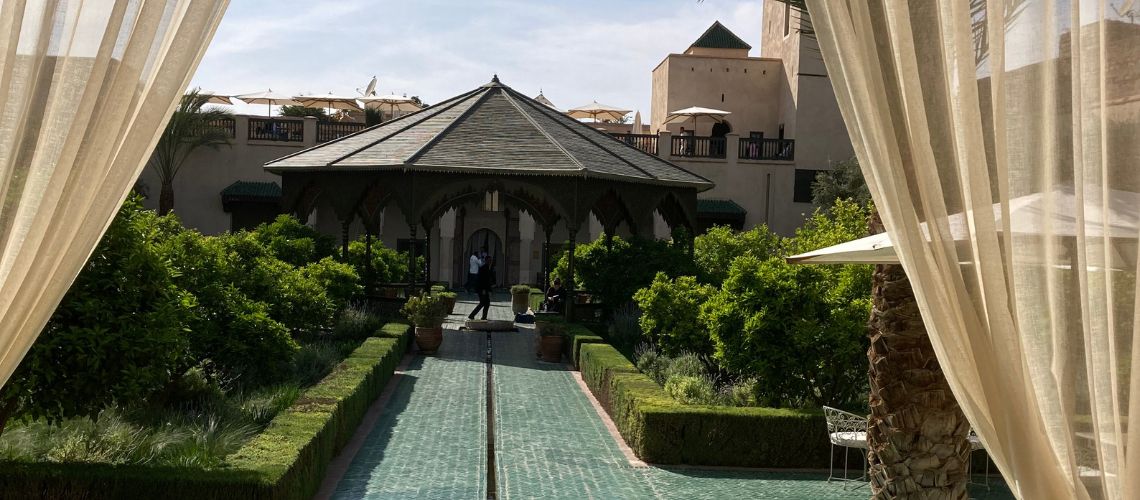
Le Jardin Secret
Tucked away in the bustling heart of the Medina, Le Jardin Secret is one of Marrakech’s most enchanting hidden gems. Dating back to the 16th century, this beautifully restored historic property offers a rare sanctuary of calm amid the sensory intensity of the souks.
The site is divided into two distinct gardens: an Islamic garden, designed around the classical principles of symmetry and water flow, and an exotic garden, filled with rare plants gathered from across the globe. Both are framed by elegant Moroccan architecture, with intricate tilework, carved cedar wood, and ornate fountains at every turn.
Beyond the gardens, visitors can explore a small but fascinating museum detailing the property’s history and the families who once called it home. Climbing the garden’s tall water tower rewards you with sweeping rooftop views over the Medina and the distant Atlas Mountains — well worth the ascent.
Le Jardin Secret is open daily and is conveniently located just off the famous Rue Mouassine. It’s equally wonderful to visit in the cooler morning hours or as a peaceful afternoon escape. Entry fees are modest, and guided tours are available.
A must-visit for anyone seeking beauty and serenity in Marrakech.
The Menara Gardens
Less visited than the Majorelle, the Menara is a vast olive grove — over a hundred hectares — surrounding a large reflective pool fed by an underground khettara, an ancient system of irrigation channels that brings water from the Atlas Mountains. The pool has been here, in some form, since the twelfth century.
The pavilion at the water’s edge — restored in the nineteenth century — is pretty enough, but the real experience of the Menara is the olive grove itself. These trees are ancient. The shade they cast is deep and cool. Marrakshi families come here in the evenings and at weekends; you will see people having picnics, children playing, old men sitting in the shade talking. It is a much more local experience than the Majorelle, and the more honest portrait of how the city uses its green spaces.
The Agdal Gardens
Larger still, and less visited still, the Agdal is an immense walled garden south of the Royal Palace. Like the Menara, it is fed by the ancient khettara system, and like the Menara it has been a royal garden since the twelfth century. It contains olive, fig, pomegranate and citrus orchards of considerable antiquity, and two large pools — the Grand Bassin and the Dar el-Hana basin — that were used for royal boating parties and, more practically, for irrigating the surrounding area.
The Agdal is only open to visitors at weekends. Go on a Friday afternoon when it opens and you will have long stretches of it almost to yourself. The combination of scale — the garden is over four kilometres long — and the antiquity of the trees gives it a quality of silence and timelessness that I have found in very few places. It is not exciting. It is something better: genuinely restorative.
A Few Honest Practicalities
Marrakesh, indeed all of Morocco is an amazing place, but it requires time and an open mind to get to know it, the culture is very different from that of the West. I find it is best to fully embrace it, don’t get frustrated at shopkeepers trying to sell you’re their wares when you just want to look, that is their job. Here selling is more active, you tell the shopkeeper what you want, they show you what they have. The shopkeepers in the souks do not exist for the benefit of the tourists, each one is a small business, whose workers are trying to make a living to feed their families.
There are cultural differences on the role of women, do not assume that women who are covered up are being oppressed, that is their culture. They will dress differently when they are at home.
Moroccans are on the whole, very friendly and hospitable people and generally great fun. However Moroccans are muslim, and their religion is very important to them so treat it with respect. Show them respect and they will reciprocate.
Treat beggars with compassion, there is no social security here, a few dhiram might not seem much to you, but for them it is a meal. So judge each case on it’s merits, give a poor homeless woman a few dhiram to feed her children, it’ll make you feel good about yourself. You can’t give to everyone, but a smile and a sympathetic “I’m sorry’ don’t cost you anything.
Click here to read our practical tips for Independent Travellers to Morocco
The heat in July and August is serious and the medina is at its most crowded. April, May, September and October are the better months — warm, manageable, and the light in spring and autumn is beautiful. The Atlas Mountains, forty minutes by car from the city, hold snow into late spring and are worth a day trip even if only to understand the physical geography that has shaped the city.
One World is Enough
I’m Peter , the founder of the Inspirational Traveller. I set up One World is Enough 30 years ago after spending a year travelling around Asia in the mid 90’s. On my travels I met lots of talented artisans making the most amazing things, they just needed a market for them in the West.
So I started working with them, firstly through selling on market stalls and music festival stalls. This soon grew into a shop and then a bigger shop, then an online business. Now we send One World is Enough’s collection of fair trade clothes and crafts around the World.
We design and source all our products from our own network of fair trade producers.
We produce our own range of beautiful vibrant fair trade clothes and crafts for beautiful vibrant people!
We do this by working with our own team of lovely small scale producers in India, Nepal, Indonesia, Thailand, Laos, Morocco & Afghanistan.
All our designs are made in short runs, and when they’re gone, they’re gone!
The Inspirational Traveller
People kept asking about my travels to some of the more unusual, off the beaten track destinations that I travelled to. So I set up the Inspirational Traveller, as a curated travel guide.
I write these guides and itineraries, when I have the time, so it is a bit of a slow process, but I am adding more and more content, as I get the time.
The Inspirational Traveller is designed to a curated travel guide, to inspire you about places to visit, rather than be an exhaustive guide.
Hope you enjoy it!
