
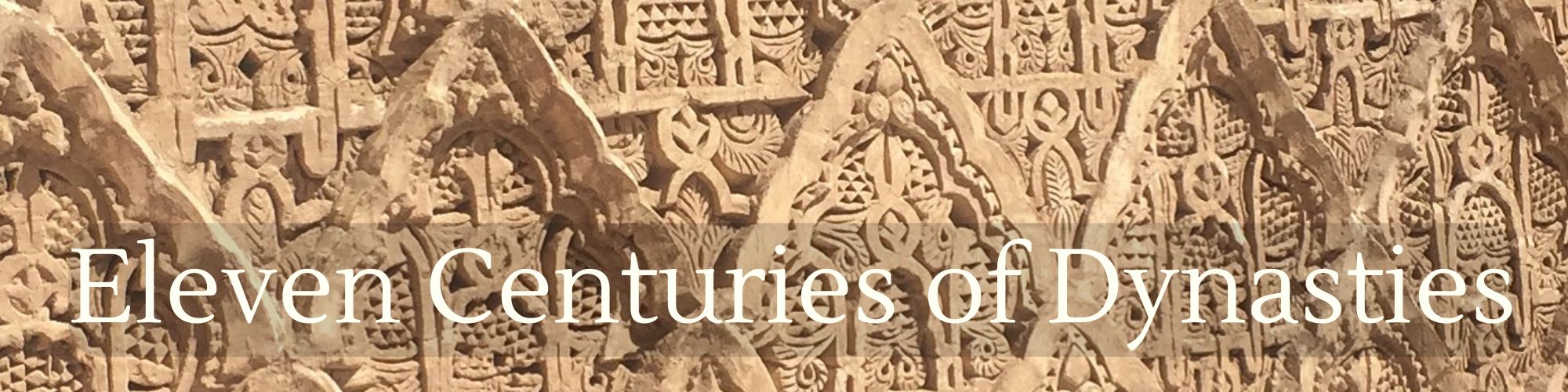
Eleven Centuries of Dynasties
Morocco’s modern name in English comes, via Spanish, from Marrakesh — which was the capital of successive dynasties and gave its name, in the eyes of medieval European traders and travellers, to the whole country. The country’s own name for itself is Al-Maghreb, the West, which locates it precisely in its historical and geographical relationship to the wider Islamic world: Morocco is where the Arab world ends, the point at which Islam reached the Atlantic and, in 711 AD, crossed it to begin seven hundred years in the Iberian Peninsula.
The Amazigh — the Berber peoples — were here long before the Arabs. They had already absorbed Phoenician trading posts, Carthaginian influence, and three centuries of Roman rule by the time the first Arab armies arrived in the late seventh century. The Romans called this corner of North Africa Mauritania Tingitana, and the ruins of Volubilis — a Roman city of genuine scale and elegance, preserved by the earthquake that destroyed it and the fact that it was simply abandoned rather than built over — remain one of the most compelling archaeological sites in North Africa. It is worth a visit not because it is especially well-preserved by Roman standards, but because of what it tells you about the reach of empire and the strangeness of finding a forum, intact mosaics and a triumphal arch in the middle of Morocco.
The Arab conquest brought Islam, which took hold with a speed and thoroughness that suggests it answered something in the population. By 789, Idriss I — a descendant of the Prophet who had fled political violence in Arabia — had established the first Moroccan Islamic kingdom, and his son Idriss II founded Fez as its capital. Fez became, within a century, one of the great centres of Islamic learning and culture in the world: a position it has never entirely relinquished.
What followed was a succession of dynasties — Almoravid, Almohad, Merinid, Saadian, Alaouite — each of which left its mark on the landscape in the form of mosques, medersas, palaces and city walls that you can still visit today. The pattern of Moroccan history is not one of settled continuity but of cyclical renewal: a dynasty would rise, build magnificently, extend its power across the Sahara or into Spain, decline, and be swept away by a new force from the Atlas or the desert or the south.
The Almoravids, an Amazigh dynasty from what is now Mauritania, founded Marrakesh in 1070 and built an empire stretching from Andalusia to sub-Saharan Africa. The Almohads replaced them and built more grandly still — the Koutoubia mosque in Marrakesh and the Giralda tower in Seville were designed by the same architects under Almohad patronage, which tells you something about the cultural ambition of the period. The Merinids made Fez into an architectural treasury. The Saadians fought the Portuguese, expelled them from the Atlantic coast, and built the El Badi Palace in Marrakesh on the proceeds of a victory so total that it became legendary. The Alaouites — the current royal dynasty, still on the throne — have ruled since the seventeenth century, which makes the Moroccan monarchy one of the oldest continuous royal lines in the world.
The French protectorate, established in 1912 and ended by independence in 1956, left its mark too — in the wide boulevards of the new towns built alongside every medina, in the French that remains the language of education and business alongside Arabic and the Amazigh tongues, in the cafe culture that coexists, sometimes surprisingly harmoniously, with Islamic tradition. Morocco is a country of genuine complexity, and its history is one of the reasons why.