


email us hello@inspirational-traveller.com


Meknès - The Forgotten Imperial City
I love Meknès, it is one of Morocco’s four Imperial Cities, that is cities that were once the capital. The others were Fez, Marrakesh & Rabat, the current capital.
Morocco’s fourth imperial city, at sixty kilometres from Fez and ninety from Rabat, it sits in the middle of a country whose most famous destinations draw enormous crowds, and yet it receives a fraction of the visitors that those destinations attract. The result is a city where you can walk through a magnificent gate and have it to yourself, where the medina’s souk operates as a genuine market rather than a tourist experience, and where the evening square has the character of a local gathering rather than a performance for visitors.
I have loved Meknès since my first visit in the late nineties. It is not the most spectacular city in Morocco — Fez has deeper history, Marrakesh more grandeur — but it has a quality of dailiness and authenticity that the more visited cities sometimes struggle to maintain. The imperial architecture is extraordinary. The food is excellent and unpretentious. The people are accustomed to visitors without being defined by them. Let me show you around.
You can zoom in and out on the map and click on the various elements for more information.
The City of Moulay Ismail
Meknès is, above all, the creation of a single man with unlimited ambition, unlimited resources, and fifty-five years to realise his vision. Moulay Ismail ibn Sharif, sultan of Morocco from 1672 to 1727, inherited a fragmented country and spent his reign assembling it by force into a centralised state. He was a contemporary of Louis XIV — he even proposed marriage to Louis’s daughter, a proposal the French court declined with considerable diplomatic care — and he was not immune to the competitive instincts of absolute monarchy. He decided to build a capital that would rival Versailles, and he built it in Meknès.
The scale of what Moulay Ismail built is still staggering. Forty kilometres of walls enclose the imperial precinct. The granaries — the Heri es-Souani — are a series of vaulted underground chambers capable of storing enough grain to feed an army and the city for twenty years. The royal stables could house twelve thousand horses. The palace complex, most of which was destroyed by the earthquake of 1755, originally covered an area of several square kilometres. The Bab Mansour gate — the ceremonial entrance to the imperial city — is among the most extraordinary pieces of monumental architecture in Africa.
Moulay Ismail used every resource available to build this city. Prisoners from the European slave trade — several thousand at any one time — were set to work alongside Moroccan labour. Stone and marble were taken from Volubilis, the Roman city thirty kilometres to the north; from El Badi Palace in Marrakesh, stripped a decade earlier; from wherever the sultan’s reach extended. The pragmatism was absolute and the result magnificent.

Bab el-Mansour: The Gate That Commands Attention
The Bab el-Mansour gate is one of those pieces of architecture that stops you physically when you first encounter it. It is not the largest gate in Morocco — Bab Oudaia in Rabat and Bab Agnaou in Marrakesh are both impressive — but it is the most elaborately decorated and, in my view, the most beautiful. Built by Moulay Ismail and completed in 1732 by his son, it stands at the southern edge of the Place el-Hedim, the great square of the old city, and combines Corinthian columns taken from Volubilis with panels of green and white zellige tilework and an arch of proportions so confident that it seems to have always been there.
The name Bab el-Mansour comes from the Christian slave — Mansour, ‘the victorious’ — who is said to have designed it, converted to Islam during its construction, and been executed by the sultan on its completion to ensure that he would never build anything equally fine for anyone else. The story is probably legend. The gate is certainly real.
The gate is at its best in the late afternoon, when the low sun catches the zellige from the west and the colours change from green to turquoise to something approaching gold. Go on a weekday morning and the square before it will be quiet enough to stand and look without interruption. This is the experience Meknès makes possible that Marrakesh no longer can.
The Mausoleum of Moulay Ismail
The mausoleum of Moulay Ismail, which contains the tomb of the sultan himself and those of several of his wives and children, is one of the few Islamic religious sites in Morocco that non-Muslims are permitted to enter in full. You are asked to remove your shoes and to dress modestly — as you would anywhere — and in return you are given access to a series of rooms of considerable beauty: carved stucco walls, painted cedarwood ceilings, zellige floors and the central chamber where the sultan lies in a marble sarcophagus beneath a clock that was given to him by Louis XIV as a diplomatic gift.
The mausoleum is still actively used for worship — pilgrims come, prayers are said, the spiritual function of the place is entirely real. Being present in it as a non-Muslim, in a place of living religious practice, is a more interesting experience than visiting an empty monument. There is an atmosphere of genuine sanctity here that you do not find in a museum.

The Heri es-Souani: Engineering as Architecture
The royal granaries and stables — the Heri es-Souani — are another world. Built to provision the sultan’s army and feed the city during siege, they extend for hundreds of metres beneath the palace complex in a series of underground vaulted chambers, the walls a metre thick to regulate the temperature for grain storage. Above ground, the ruined roof — the earthquake of 1755 brought it down — has been left as it fell, creating a landscape of broken stone and open sky that has a strange, accidental grandeur.
Adjacent to the granaries is the Agdal basin — a large ornamental lake, fed by underground channels from the mountains, that served both as an aesthetic feature of the imperial complex and as an emergency water reserve. The combination of the ruined granaries, the reflective basin, and the mountains visible on the horizon makes this one of the more unusual and evocative spaces in any Moroccan city.
The first time I was in Meknès was during the first Gulf War, when understandably, the British were not too popular.
I remember pretending to be French and chatting to a guy in the market. He said, “Allons prendre un thé?”, I said “Oui!”, and off we went, I thought we were just going to a local tea shop and I started getting slightly alarmed as the noises of the medina began to fade away and were replaced by the stillness of the alleyways of the old city in the middle of the day. I started thinking maybe this wasn’t such a good idea, I was about to make my excuses when he opened an old timber door leading off the alleyway.
Behind the door was a lovely old Riad, it was his family home and for the next few hours I met the whole family, and was entertained by lots of food and family stories. I was very touched that somebody I was just talking to in the market would be so warm and hospitable that he would take me home to meet his family, you couldn’t imagine it happening in England!

Meknès features in our one week in the north, two, three and four week itineraries.
Our itineraries are guides to how I would spend a week, or more touring Morocco, trying to see as much as is possible in the time you have available. The travelling is part of the experience, I always want to see as much as possible without the actual travelling becoming a chore. Sometimes I think you discover more about a country by spending a few days in one place rather than racing around trying to tick of as many sights as possible.
The Medina and its Souks
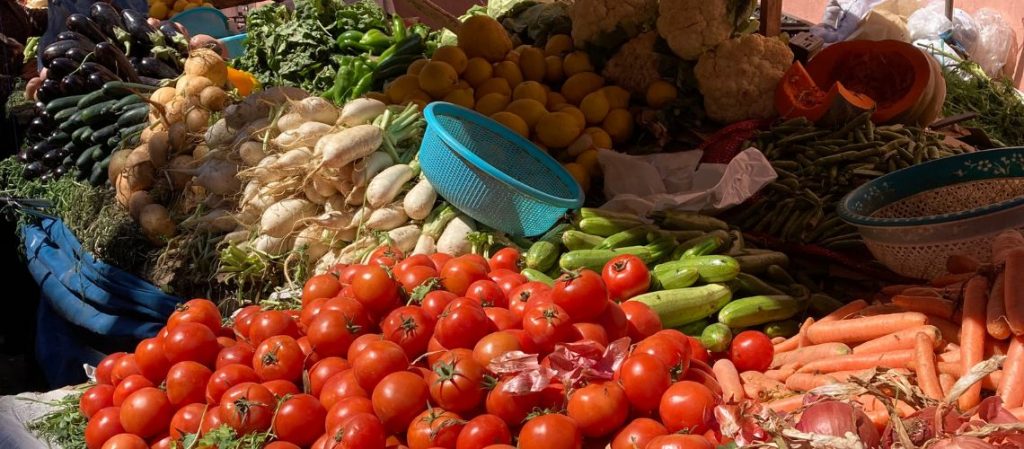
Meknès’s medina is smaller and more navigable than Fez’s, and its souk — centred around the Place el-Hedim — is one of the most genuinely Moroccan markets I have encountered. The evening food market in particular, when stalls appear selling freshly cooked snails, harira, kebabs and a dozen varieties of Moroccan pastry, is an experience of local life rather than tourism. Bring a bowl and join the queue at the snail stall. The snails are cooked in a herb broth and eaten with a toothpick from the shell; the flavour is mild and the experience entirely authentic.
The craft tradition of Meknès is distinctive in one particular: damascening, or damasquinerie, the art of inlaying fine silver wire into darkened iron or steel. The technique, which originated in Damascus and was brought to Morocco via the Andalusian tradition, is now practised mainly in Meknès and produces decorative objects — trays, boxes, candlesticks — of considerable delicacy. The workshops in the medina lanes near the Bab Mansour gate are worth a visit to watch the process, which involves a small chisel, extraordinary patience, and the kind of focus that makes conversation difficult.
Day trip: Meknès is the ideal base for Volubilis. The Roman city is thirty kilometres north, easily reached by taxi, and the combination of a morning at Volubilis and an afternoon in Meknès — with the evening market and dinner in the medina — is one of the finest days available anywhere in Morocco.
Meknès is the city I recommend to people who want imperial Morocco without the crowds, authentic markets without the tourist overlay, and a pace of life that allows you to actually look at things. It is not the most glamorous choice. It is, in my experience, often the most satisfying.

One World is Enough
I’m Peter , the founder of the Inspirational Traveller. I set up One World is Enough 30 years ago after spending a year travelling around Asia in the mid 90’s. On my travels I met lots of talented artisans making the most amazing things, they just needed a market for them in the West.
So I started working with them, firstly through selling on market stalls and music festival stalls. This soon grew into a shop and then a bigger shop, then an online business. Now we send One World is Enough’s collection of fair trade clothes and crafts around the World.
We design and source all our products from our own network of fair trade producers.
We produce our own range of beautiful vibrant fair trade clothes and crafts for beautiful vibrant people!
We do this by working with our own team of lovely small scale producers in India, Nepal, Indonesia, Thailand, Laos, Morocco & Afghanistan.
All our designs are made in short runs, and when they’re gone, they’re gone!
The Inspirational Traveller
People kept asking about my travels to some of the more unusual, off the beaten track destinations that I travelled to. So I set up the Inspirational Traveller, as a curated travel guide.
I write these guides and itineraries, when I have the time, so it is a bit of a slow process, but I am adding more and more content, as I get the time.
The Inspirational Traveller is designed to a curated travel guide, to inspire you about places to visit, rather than be an exhaustive guide.
Hope you enjoy it!

 |  |  |  |