


One Week in the South: - Marrakesh · Essauoria · Aït Benhaddou · Taroudant · Taliouine
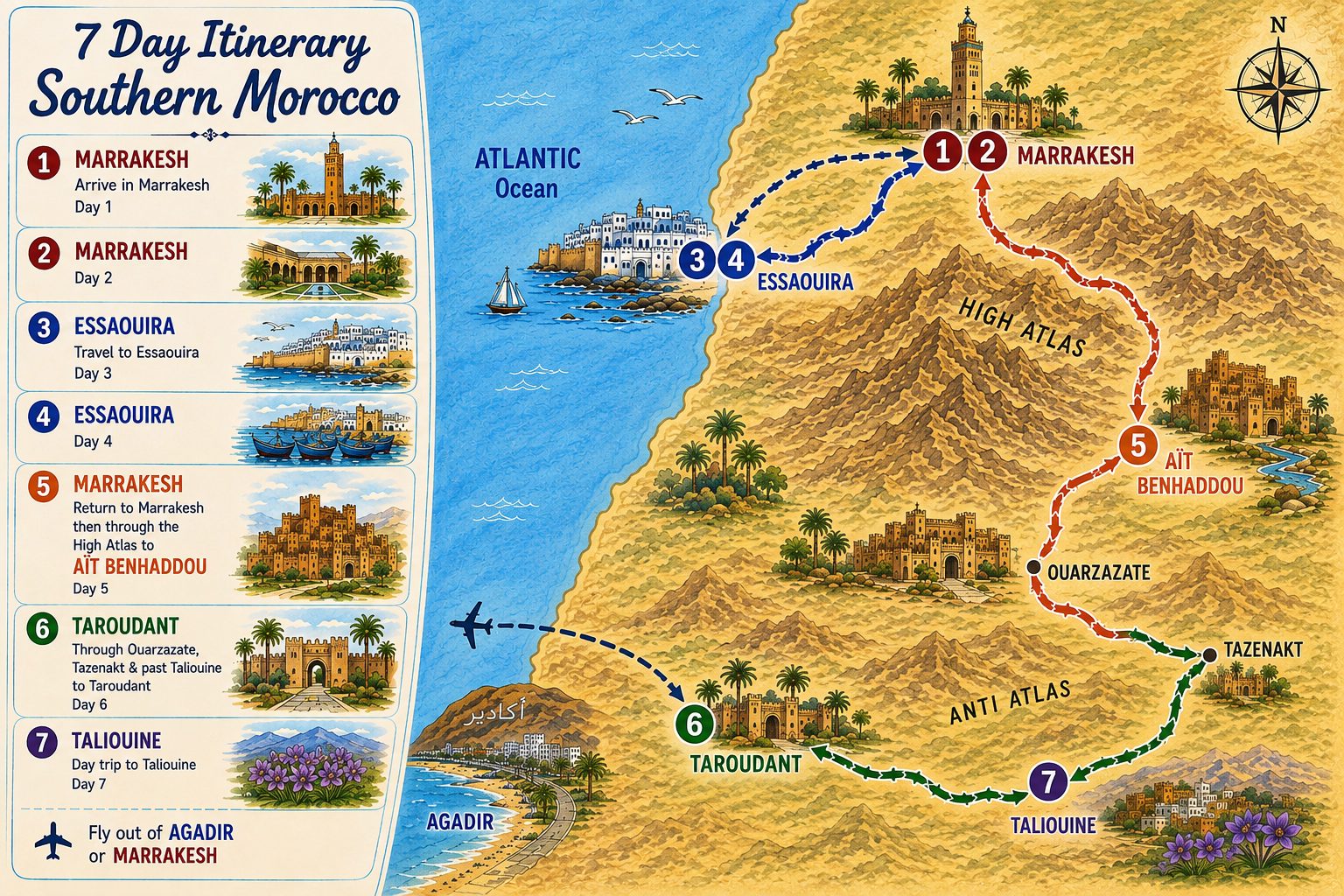
Morocco is a big country, roughly the size of France, it is not possible to visit the whole country in seven days , so we have created two seven day itineraries, one covering the North of Morocco and the other one the South of Morocco.
The south of Morocco — Marrakesh and the Atlantic coast and the landscapes between them — is the most visited part of the country, for good reason. It is the quintessential Morrocco, it is an area of great variety that really makes you feel as if you have been transported to a foreign and exotic land, far removed from your home country. This itinerary uses Marrakesh as its anchor and gateway, reaches west to Essaouira on the Atlantic, touches the edge of the High Atlas, and ends in Taroudant — the secret that knowing travellers keep to themselves. It is a journey that moves between the famous and the genuinely unknown, between spectacle and intimacy, between the red city and the blue sea.
So let me share with you, my curated guide to Southern Morocco, each itinerary includes an interactive google map, links to more detailed guides to each of the cities we visit, a guide to Moroccan food, practical notes on the itinerary plus a bonus practical section on travel in Morocco. Enjoy the ride!
Day 1 · Marrakesh — Introduction and acclimatisation
Fly into Marrakesh Menara airport. Catch a taxi to your Riad, for an atmospheric and authentic stay I would strongly recommend booking a Riad within the walls of the medina.
Click here to read our detailed guide to Marrakesh
Your first day in Marrakesh is for orientation and the great square, the Djemaa el-Fna. Arrive in the morning, and spend the first day exploring the medina on foot without a fixed agenda. Have lunch at a café overlooking the Djemaa el-Fna and watch the juice sellers, the henna women, the snake charmers, spend the afternoon wandering through the souks and come back to the Djemaa el-Fna for dinner again in the evening, when the food stalls assemble and the gnawa musicians begin. The two visits to the same square in the same day are utterly different, during the day it is quite sedate, but at night it really comes alive.

Day 2 Marrakesh; The sights
On your second day in Marrakesh, now you have your bearings, I would suggest visiting the sites, the souks and the monuments.
I would start the morning by catching a taxi to my favourite place in Marrakesh, indeed one of my favourite places in the World, Les Jardins des Majorelles. If you can, be there when it opens, first thing, before the crowds arrive. The cobalt blue against the bougainvillaea, the sound of the birds, the sheer exoticism is magical in the quiet of the early morning, especially without the crowds. Don’t forget to visit the Berber museum in Majorelle’s old studio that most visitors walk past.
I would stay for a couple of hours, there is a lovely, although rather pricey, café on site.
Next head back into town to something completely different, the dyers’ souk — a lane strung with hanks of freshly dyed wool in shades of saffron, crimson and indigo, hung between the buildings to dry. If you find the dyers’ souk — and finding it involves taking a small lane that feels like you are going the wrong way, but keep going — stop and look up. The colours against the pale walls and the strip of sky above is one of the most photogenic scenes in the medina.
The next stop I would suggest is the Medersa Ben Youssef, the ancient Islamic theological college which is among the finest Islamic interiors in Africa and should not be rushed. It has been restored in the last few years and is magnificient.
After a late lunch, I would suggest visiting atmospheric palaces; the Bahia Palace (painted ceilings of extraordinary quality) and the El Badi Palace ruins (the storks on the battlements, the sense of magnificent loss).
Click here to read our Moroccan Food Guide
Finish the afternoon at the Saadian Tombs, discovered behind a wall in 1917 and preserved in the condition in which they were sealed: a jewel-box of carved marble and painted stucco containing the remains of the Saadian dynasty.
Marrakesh eating: I would suggest eating at a stall in the Djema el-Fna one eveing to experience the atmosphere and enjoy dinner at one of the restaurants overlooking the square for your second evening.
For lunch there are plenty of atmospheric places in the medina, although after the very generous Riad breakfasts, you may not be that hungry. There are also plenty of places to rest and enjoy a refreshing mint tea
Key: A Marrakesh, B Essauoria, C Aït Benhaddou, D Ouarzazate, E Taroudant, F Taliouine, G Agadir
You can zoom in and out on the map and click on the various elements for more information.

Day 3 · Essaouira — The Atlantic
Three hours west of Marrakesh by comfortable bus or shared taxi, Essaouira is a different Morocco entirely: white and blue where Marrakesh is red and gold, Atlantic where Marrakesh is continental, breezy and salt-tanged where Marrakesh is dusty and warm. The bus from Marrakesh’s Bab Doukkala station runs several times daily and is the most straightforward connection.
Click here to read our guide to Essaouria
Arrive late morning and go immediately to the port. The fishing boats are in by now, the fish market is operating, and the stalls along the quay are grilling the morning’s catch. This is where to eat lunch: choose your fish from the display, watch it go over the charcoal, eat it at a tin table with bread and harissa. The prawns are consistently good. So are the sardines. It will cost very little and taste of the sea and the day.
After lunch walk the skala — the sea bastion — with its bronze cannons pointing at the Atlantic and the thuya woodworking workshops in the chambers below. The view of the medina from the ramparts and the offshore islands visible through the sea haze is very atmospheric. Then explore the medina itself: the main commercial street, the gallery quarter (the standard of the galleries in Essaouira is the highest of any Moroccan city outside the major imperial cities), the mellah — the old Jewish quarter — which still carries the architectural character of the Sephardic community that made the city’s Atlantic trade for two centuries.
Evening in Essaouira has a particular quality — the wind drops as the sun goes down, the temperature cools, the medina lanes belong to the people who live in them. Find yourself a good fish restaurant and enjoy the Moroccan seafood.

Day 4 · Essaouira — The Wind and the Coast
A full second day in Essaouira. I would start early, straight after breakfast, and head to the beach — the wide Atlantic strand to the south of the city, it is best before the fresh Alizé wind rises around noon. The water is cold by Mediterranean standards; the beach is magnificent, wide expanses of sand as far as the eye can see.
I like to walk along the beach, past the old ruined place lost amongst the dunes, to the village of Diabat, where Jimi Hendrix and other hippies came to avoid the Vietnam war draft in the last 1960’s. Diabat itself in a quiet place although there is a Jimi Hendrix guesthouse where you can grab a drink and have a rest. The walk back along the road is a lot quicker than the walk out along the beach. This walk is all about the journey rather than the destination.
I would suggest lunch back in the medina, then spend the afternoon exploring the medina again at your own pace. The souks here are more relaxed and generally have a higher quality of goods than those in Marrakesh: the argan oil is local and genuine, the woven textiles are Rif and Souss traditions, the thuya marquetry is made in workshops you can watch. The Gnawa music that appears in the squares and tea houses is the real tradition, not a tourist performance — the same tradition that influenced Jimi Hendrix when he came through in 1969.
Stop somewhere in the medina, order a mint tea and soak in the atmosphere
Head the ramparts at sunset. You won’t be alone, sunset here is a major attraction, for a very good reason. There is a spot on the northern end of the skala where the light falls on the ocean and the old Portuguese fortifications simultaneously, and the effect is one of those moments where the beauty of a place stops being backdrop and becomes the whole point. It is hard to take a bad photograph.
Day 5 · The High Atlas — Aït Benhaddou and the Mountain Road
Today, is a road day. Catch the morning bus back to Marrakesh( three hours ) and then continue east toward the High Atlas. The journey east of Marrakesh is best done with a hired car and driver, which gives the flexibility to stop at the viewpoints and villages that make the Atlas crossing worthwhile rather than merely necessary. I would strongly recommend organising this in Marrakesh while you are there, rather than just taking a shared taxi from the bus station.
Alternatively it might be easier, although pricier, to get a car and driver in Essaouira for the whole journey to Ouarzazate.
East of Marrakesh the road over the Tizi n’Tichka pass — the main Atlas crossing at 2,260 metres — is one of the great mountain drives in Africa: the landscape changes from red earth and argan trees below to cedar forest and then bare rock as the road climbs, the views over the southern plateau appearing and expanding as you crest the pass. In winter, snow can close the road; in spring, the verges are full of wildflowers and the Atlas villages below are a patchwork of cultivation and stone.
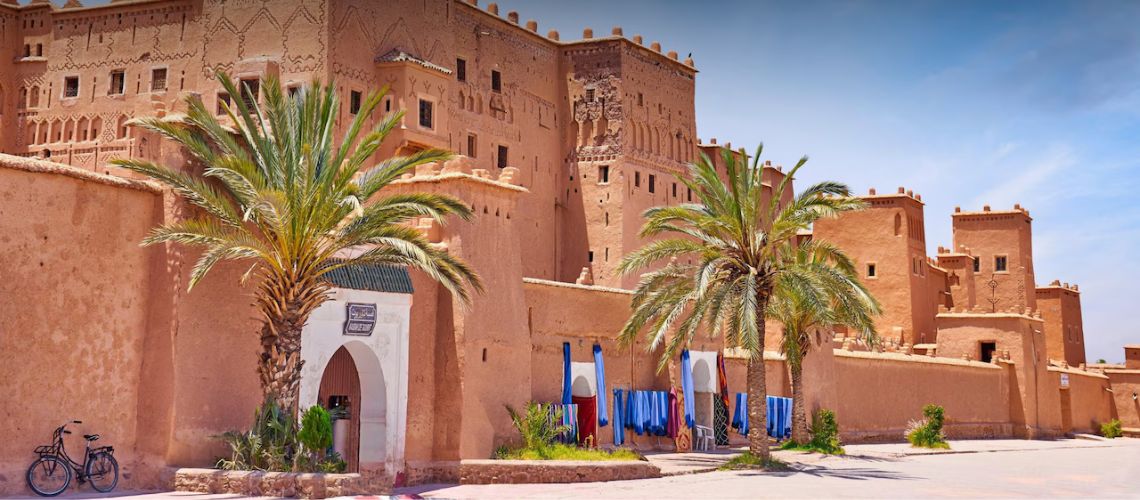
Stop at Aït Benhaddou, thirty kilometres west of Ouarzazate — the great mud-brick ksar on its hillside above the river, a UNESCO World Heritage Site and the backdrop for more films than any other location in Morocco. Go late afternoon for the best light on the towers. Cross the river, climb the ksar, look back from the top at the valley and the desert landscape extending south.
Here you have a choice, you could stay in Aït Benhaddou overnight, otherwise head on to the functional yet beautifully located city of Ouarzazate, the so-called “door of the desert.” The city has earned unlikely fame as Africa’s Hollywood, as it is home to possibly the World’s largest movie studios ( by area).
Click here to read our detailed guide to Ouarzazate, Aït Benhaddou & the Draa valley
Driving note: The Tizi n’Tichka road is well-maintained and entirely manageable by car. Do not attempt it in ice or fog without local advice. A driver who knows the road is worth the cost for the pass section, even if you prefer to drive yourself on the plateau.

Day 6 · Taroudant — The Secret City
From Aït Benhaddou, the road south follows the N10 as it traces the pre-Saharan fringe — a route that feels less visited, more honest, and in places genuinely remote.
The road passes through Ouarzazate,. It’s worth a brief stop, but the N10 pulls you onwards into the Draa Valley corridor, where the light takes on a different quality — harder, more direct, stripped of the atmospheric haze that softens the northern slopes.
The market town of Tazenakht sits at a crossroads in the truest sense: known above all for its Oulad Yahia carpets, woven by Amazigh women in deep reds and geometric patterns that carry lineages of meaning most visitors can’t read but instinctively respond to. The weekly souk draws traders from across the surrounding plateau, and it remains refreshingly untouched by the heritage-tourism circuit.
Beyond Tazenakht, the road climbs again through the Anti-Atlas — older, more eroded than the High Atlas, the geology here Precambrian — before descending through argan country into the Souss Valley, and finally Taroudant’s rose-pink walls.
The drive to Taroudant takes around 4 hours but I would allow six to allow for stops. Aim to arrive mid-afternoon and go directly to the ramparts — the great pisé walls of the Saadian dynasty, run seven kilometres around the old city, it is quite amazing watching the colour of the walls shifting from sand to ochre to deep rose as the day advances.
In the Late afternoon walk or for an authentic experience that will stay with you forever ride the full circuit of the ramparts on horseback in the hour before sunset. The light on the pisé at this hour is the thing that you will remember.
The Souss valley extends south, the High Atlas fills the northern horizon, the city is quiet below.

Day 7 · Taroudant and Return
Today spend a final morning in Taroudant. Have breakfast in the square: I would order msemen from the women cooking at the roadside stalls, coffee, orange juice squeezed to order.
Then head into the medina. The medina has two souks, the Berber market and the Arab market — each with its own character and each genuinely local rather than tourist-facing. The Amazigh jewellery in the Berber market is among the finest and most distinctive in Morocco. The spice merchants of the central lanes have stocks of saffron from Taliouine — the best-quality saffron in Morocco, grown two hours to the east — at prices that reflect a local rather than a tourist economy.
The morning market in the Place Assarag — at its best on Thursdays and Sundays when the surrounding rural population comes to town — is the finest expression of the city’s commercial character.
If you have an extra day or so, I would recommend staying in Taroudant and exploring. Taroudant is the ideal base for exploring southern Morocco beyond the tourist circuit.
The saffron fields around Taliouine, two hours east on the road to Ouarzazate, are the largest in Morocco and produce a significant percentage of the world’s finest saffron. The harvest period in October and November — when the purple crocus flowers are picked at dawn before the petals open fully, and the entire plain is the colour of the flowers — is one of the most extraordinary seasonal spectacles in Morocco. Visit at any time and the landscape of the Taliouine valley, surrounded by the Sirwa massif, is exceptional.
The Anti-Atlas to the south of the city, accessible by road through a landscape of argania and red rock, contains some of the oldest fossil sites in Morocco — trilobites and ammonites, extraordinarily preserved, that you can buy from roadside dealers or, better, find for yourself in the geological exposures of the hillsides.
If you are heading home, I would suggest transfering to Agadir (one hour) for flights to Europe, or back to Marrakesh (two and a half hours) for wider connections. Both airports have direct flights to the UK and major European cities.
Practical Notes — One Week in Southern Morocco
Fly into: Marrakesh Menara (RAK). Fly out of: Agadir Al Massira (AGA) or Marrakesh Menara (RAK).
Getting around:
Marrakesh–Essaouira (3 hours); A comfortable bus from Marrakesh’s Bab Doukkala station runs several times daily and is the most straightforward connection or alternatively shared taxi
East of Marrakesh I would suggest a hired car with driver for the Atlas crossing and the Taroudant section — the flexibility this provides is worth the cost. Alternativelty it is possible to travel by bus or shared taxi, but this generally takes a lot longer, and you cannot stop and see things on the way.
Return transfer Taroudant–Agadir is one hour by taxi. Marrakesh is three and a half hours by taxi or 5 hours by bus
Best season:
October–April for the south. Summer (June–August) in Marrakesh and the pre-Saharan areas is hot enough to be challenging. Essaouira is cooler year-round due to the Atlantic wind. The Atlas pass can be snowbound December–February; check conditions before attempting.
Accommodation:
Marrakesh; Riad in the medina for nights 1–2.
Essaouira; Riad or small hotel inside the medina for nights 3–4.
Ouarzazate or Aït Benhaddou (if doing the Atlas crossing) guesthouse for night 5.
Taroudant; Riad in the medina or the Palais Salam for night 6.
Click here to read our Moroccan Food Guide
Click here to read our practical tips for Independent Travellers to Morocco
One week reality check: This itinerary is full. If you find yourself wanting to stay longer in Essaouira or linger in the Atlas, stay longer. Marrakesh can be reduced to one day if you have been before. Taroudant is the stop most likely to make you want more time than the itinerary gives you. As you have made all the effort to get here why not stay another day

One World is Enough
I’m Peter , the founder of the Inspirational Traveller. I set up One World is Enough 30 years ago after spending a year travelling around Asia in the mid 90’s. On my travels I met lots of talented artisans making the most amazing things, they just needed a market for them in the West.
So I started working with them, firstly through selling on market stalls and music festival stalls. This soon grew into a shop and then a bigger shop, then an online business. Now we send One World is Enough’s collection of fair trade clothes and crafts around the World.
We design and source all our products from our own network of fair trade producers.
We produce our own range of beautiful vibrant fair trade clothes and crafts for beautiful vibrant people!
We do this by working with our own team of lovely small scale producers in India, Nepal, Indonesia, Thailand, Laos, Morocco & Afghanistan.
All our designs are made in short runs, and when they’re gone, they’re gone!
The Inspirational Traveller
People kept asking about my travels to some of the more unusual, off the beaten track destinations that I travelled to. So I set up the Inspirational Traveller, as a curated travel guide.
I write these guides and itineraries, when I have the time, so it is a bit of a slow process, but I am adding more and more content, as I get the time.
The Inspirational Traveller is designed to a curated travel guide, to inspire you about places to visit, rather than be an exhaustive guide.
Hope you enjoy it!

 |  |  | ; |