


One Week in the North: - Tangier · Chefchaouen · Tétouan · Fez · Meknès · Volubilis
Morocco is a big country, roughly the size of France, it is not possible to visit the whole country in seven days , so we have created two seven day itineraries, one covering the North of Morocco and the other one the South of Morocco.
The north of Morocco is the part of the country that most tourists heading to Marrakesh never see, which means it is more authentic and many places see only a handful of foreign visitors. This itinerary covers the full arc of the northern experience: the cosmopolitan port city of Tangier, the blue dreamscape of Chefchaouen in its Rif mountain bowl, the overlooked Andalusian medina of Tétouan, and the imperial grandeur of Fez, with Meknès and the Roman ruins of Volubilis rounding out the final days. Seven days is quite a tight schedule, and if you have a few more days I would advise spending them relaxing in Fez or Meknès or both.
So let me share with you, my curated guide to Northern Morocco, each itinerary includes an interactive google map, links to more detailed guides to each of the cities we visit, a guide to Moroccan food, practical notes on the itinerary plus a bonus practical section on travel in Morocco. Enjoy the ride!

Day 1 · Tangier — Arrival and Orientation
Arriving in Tangiers arrive by ferry from Tarifa or Algeciras in Spain, thirty-five minutes if you take the fast boat from Tarifa — is the best introduction to Morocco: the country appearing gradually on the horizon, the minaret of the medina visible above the port as you approach, the smell of the strait giving way to the smell of the city.
Alternatively if it better suits your plans you can Fly into Tangier Ibn Battouta airport
I would recommend staying in or immediately adjacent to the medina. Spend the first afternoon just walking, through the Petit Socco, up toward the kasbah, along the ramparts above the port.
The purpose of the first afternoon is to soak in the atmosphere and getting accustomed to the fact that you are in a very different place rather than actual sightseeing — letting your all your senses adjust to the stimuli that Morocco has to offer. Have dinner in the atmospheric medina rather than the ville nouvelle.
Tonight: Eat at a restaurant in the medina lanes rather than on the tourist-facing squares. Ask your accommodation for a recommendation, or just wander around. This principle of asking the locals, rather than consulting a guidebook, is one that I always follow and which will serve you well for the entire week.

Day 2 · Tangier — The City in Full
After Breakfast spend some time in the kasbah and visit the Dar el-Makhzen museum: the Roman mosaic collection, the carved ceilings, the view from the ramparts over the strait. By mid-morning head over to the American Legation Museum in the medina — the oldest American public property abroad, now a cultural centre with an excellent collection documenting the city’s literary history. Have lunch in the medina.
After lunch take a taxi west to Cap Spartel, the headland where the Atlantic meets the Mediterranean. Walk to the lighthouse, look at the two seas from above, then descend to the Caves of Hercules below the cliff. Return to the city in time for the late afternoon light on the strait from Café Hafa — the clifftop café that has been serving tea to musicians, writers and travellers since 1921. This is a great place to sit for an hour and watch the ferries crossing below. This is the finest thing you can do in Tangier, and it costs the price of a glass of tea.
Spend the evening in the Grand Socco and the Petit Socco for a last walk through the city at night, when the tourists have gone and the medina belongs to its residents rather than its visitors. I would eat again in The Medina, but you might like to try the Ville Nouvelle.
KEY; A Tangier, B Tétouan, C Chefchaouen, D Fez, E Volubilis F Meknès
You can zoom in and out on the map and click on the various elements for more information.
Day 3 · Tétouan — The Overlooked City, then South to Chefchaouen
Today I recommend an early start from Tangier. Take the bus or a grand taxi to Tétouan — an hour south and east through the Rif foothills. Tétouan is a half-day stop on this itinerary, which is not enough to do it full justice but is enough to understand why it deserves its own entry in this guide. The big draws are the medina — a UNESCO World Heritage Site that almost no tourists visit and the Andalusian architecture of the residential quarters, built by the Spanish Ensanche during the Protectorate years. Unfortunately on this tight schedule there is only time to spend two to three hours here before continuing south. But if you have the time you could easily turn Tétouan into an overnight stop
Click here to read our detailed guide to Tétouan
After lunch in Tétouan, take a CTM bus or grand taxi south to Chefchaouen. The journey takes around two hours, through the Rif Mountains, the road climbing through cedar forest and terraced hillsides. I would strongly recommend checking into a riad inside the medina —the city at night, when the day visitors have gone, is a different and better place, and you only experience it if you are sleeping inside the walls.
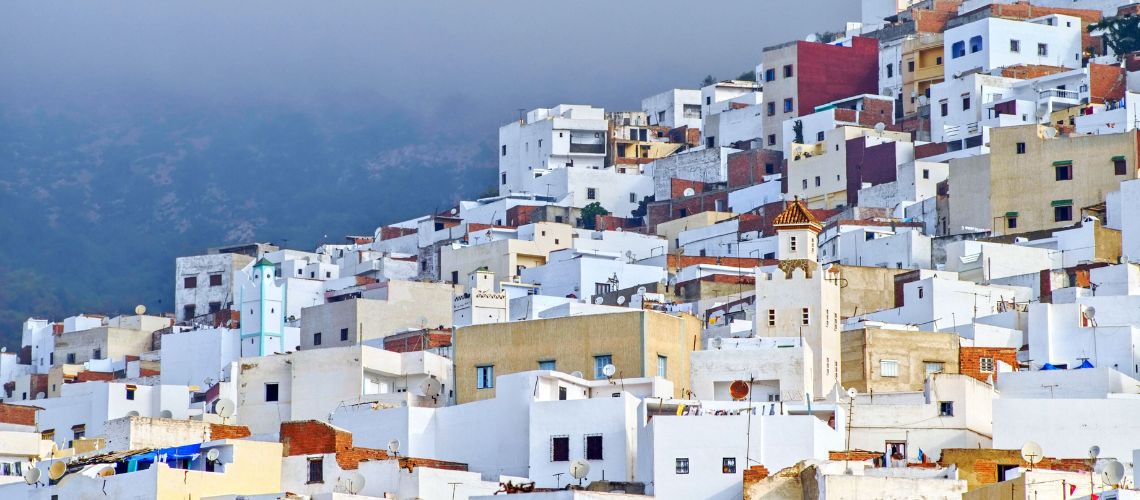
Aim to arrive in Chefchaouen, mid afternoon, the perfect time to walk up to the Spanish mosque on the ridge above the city. The path is clear, the climb takes forty minutes, and the view over the blue rooftops as the sun descends is one of the genuinely memorable sights of a Moroccan journey. Time it for an hour before sunset and you will have the light exactly right.

Day 4 · Chefchaouen , then South to Fez
Spend the morning in the medina: the Plaza Uta el-Hammam and the kasbah garden first, then simply walk. The medina of Chefchaouen is small enough to explore fully in a morning without rushing, just walk slowly, take the lanes that look interesting and allow the colour and the calm to do their work. The Ras el-Maa spring at the eastern edge of the medina, where the mountain water runs through stone channels, is worth finding.
After lunch it’s time to head off to Fez, it takes around 3 hours by bus or grand taxi. This time it might be better to catch a grand taxi as the buses all tend to come from somewhere else and are often full when they arrive in Chefchaouen.
Try to arrive in Fez by early evening. Again I would strongly recommend checking into a riad in the medina — Fès el-Bali rather than the ville nouvelle. Your first evening is for orientation: a walk through the lanes nearest your riad, have dinner close by, and you’re probably ready for an early night.

Day 5 · Fez — The Medina
Fez or Fès is medieval city, with an amazing medina that is the largest in the world, it demands at least two full days, and even that is an underestimate, I could easily spend an extra day here.
On the first day, explore Fès el Bali (the medina) ideally with a guide — this is the one city in Morocco where the argument for hiring a good local guide makes a lot of sense. The lanes of Fès el-Bali number over nine thousand; without a guide who knows the city, you will spend significant time navigating rather than seeing. But if you don’t have a guide do make sure that you have a smart phone equipped with a mapping app, without it you could get lost for days!
Click here to read our detailed guide to Fez
I would start in the morning at Bab Boujloud — the Blue Gate and proceed down Talaa Kebira to the Bou Inania Medersa. Allow at least forty minutes here: the carved stucco, the cedarwood screens, the marble courtyard with its central basin are among the finest examples of Merinid architecture in existence and deserve careful attention. Continue through the commercial souks — the leather workers, the dyers, the weavers — to the infamous Chouara Tannery, you can usually smell it before you come across it. View it from the terrace of one of the surrounding leather shops.
Have lunch in Fès el Bali and start the afternoon at the Al-Attarine Medersa, immediately adjacent to the Al-Qarawiyyin mosque. The mosque itself is closed to non-Muslims, but the medersa’s rooftop gives a rare glimpse into the mosque’s courtyard. Then proceed to the Seffarine square — the coppersmiths’ quarter, where the hammering has continued since the medieval period — and the shrine of Moulay Idriss II.
In the evening I would eat in or around the medina, try the local Fassi food. I would suggest ordering pastilla, the layered pie of pigeon (or increasingly chicken), egg, almonds and spices, encased in warka pastry as fine as tissue paper, dusted with icing sugar and cinnamon. The combination sounds improbable and tastes extraordinary. Any riad or restaurant serious about Fassi cuisine will serve a version; the best versions take a day to prepare.
Click here to read our guide to Moroccan Food
Harira — the thick, tomato-based soup with lentils and chickpeas — is another Fassi staple, and makes a great starter, it is served throughout the medina and at its best in the small restaurants around the Rcif quarter. Mrouzia — lamb slow-cooked with almonds, raisins and spice in a honey-sweetened sauce — is another firm favourite and a dish that could only have come from this culinary tradition: patient, complex, the kind of cooking that reflects centuries of refinement.

Day 6 · Fez — Depth and Digression
The second day in Fez is for exploring Fès el Bali, letting yourself get lost in the medina ( as long as you have your smart phone to show you the way out should you need it) rather than a prescribed route.
The medina has nine thousand lanes; you have seen perhaps thirty. Go back to the places that stayed with you from yesterday. Find the neighbourhood outside the main tourist circuit — the residential quartiers of the Andalusian bank, quieter and less visited than the Kairouani side — and explore.
I would begin the morning at the Merinid tombs on the hilltop above the medina — the ruins of the royal necropolis are reached by a path behind the Borj Nord fortress. The ruins themselves are modest, but the view over the medina below is the best available perspective on the scale and density of Fès el-Bali. The tiled rooftops, the minarets, the smoke from the hammam chimneys: a scene that hasn’t changed for six hundred years.
Spend the afternoon exploring the medina at your own pace. If there is a workshop, a craft quarter or a street that interested you yesterday and that you passed through too quickly, return to it. If the tanneries were what stayed with you, go back at a different time of day and in different light. If a shopkeeper invited you to tea yesterday and you were in too much of a hurry return and see him today, he’ll be delighted to see you!.

Day 7 · Meknès and Volubilis — Then Home
Meknès is sixty kilometres from Fez — forty minutes by train or taxi — and makes a natural final day before returning to Casablanca or Fez for an onward flight. Leave Fez early and arrive in Meknès by mid-morning.
I would start with Volubilis, thirty kilometres north of Meknès, it is the best-preserved Roman city in Morocco, occupying a bowl of agricultural land with the Atlas visible on the southern horizon. Go early, before the tour buses from Fez arrive. The mosaics — still in situ on the floors of the ruined villas — are extraordinary, and the triumphal arch, the capitol and the forum give sufficient sense of the city’s original scale to make the imagination do the rest. Two hours here is enough; three is better.
Return to Meknès for the afternoon, see the Bab Mansour gate (at its best in afternoon light), the Mausoleum of Moulay Ismail, the Heri es-Souani granaries and the Agdal basin. The evening food market in the Place el-Hedim — snails, harira, merguez — is the ideal final meal of a northern Moroccan journey: unpretentious, local, completely genuine.
Click here to read our detailed guide to Meknès
If you can I would spend the night in Meknès, and spend a few hours in the morning seeing the bits you missed the day before. Then return to Fez or Casablanca for a flight home.

Practical Notes — One Week Northern Morocco
The Ferry option from Tarifa or Algeciras in Spain to Tangier port is in my opinon the best way to start your Morrocan journey. Otherwise fly into: Tangier Ibn Battouta (TNG) or Casablanca Mohammed V (CMN) then catch the train north to start in Tangier.
Fly out of: Fez Saïss (FEZ) or Casablanca (CMN). Fez has direct connections to several European cities; Casablanca has the widest range.
Getting around: Grand taxis between Tangier, Chefchaouen and Tétouan. Hired car or bus Tétouan to Fez. Train Fez to Meknès (40 minutes, inexpensive, reliable). Train Meknès to Casablanca for the return flight (3.5 hours direct).
Best season: April–May and September–October. The Rif Mountains are beautiful in spring when the hillsides are green and the wildflowers are out. Avoid July and August in Fez, which is genuinely hot and crowded.
Accommodation: I would always strongly recommend staying in a Riad for an authentic and atmospheric visit. Specifically I would recommend;
Tangier; Hotel or small guesthouse in medina or kasbah quarter.
Chefchaouen; Riad inside the medina walls.
Fez; Riad in the Fès el-Bali medina.
Meknès; Riad or small guesthouse inside the medina walls, alternatively Meknès can visited as a (long) day trip from Fez.
Click here to read our Moroccan Food Guide
Guide note: Hire a guide for Fez on at least the first day. Ask your riad for a recommendation of a licensed guide — the quality varies considerably, and a good guide transforms the experience of the medina into something that a self-guided visit cannot approach.
One World is Enough
I’m Peter , the founder of the Inspirational Traveller. I set up One World is Enough 30 years ago after spending a year travelling around Asia in the mid 90’s. On my travels I met lots of talented artisans making the most amazing things, they just needed a market for them in the West.
So I started working with them, firstly through selling on market stalls and music festival stalls. This soon grew into a shop and then a bigger shop, then an online business. Now we send One World is Enough’s collection of fair trade clothes and crafts around the World.
We design and source all our products from our own network of fair trade producers.
We produce our own range of beautiful vibrant fair trade clothes and crafts for beautiful vibrant people!
We do this by working with our own team of lovely small scale producers in India, Nepal, Indonesia, Thailand, Laos, Morocco & Afghanistan.
All our designs are made in short runs, and when they’re gone, they’re gone!
The Inspirational Traveller
People kept asking about my travels to some of the more unusual, off the beaten track destinations that I travelled to. So I set up the Inspirational Traveller, as a curated travel guide.
I write these guides and itineraries, when I have the time, so it is a bit of a slow process, but I am adding more and more content, as I get the time.
The Inspirational Traveller is designed to a curated travel guide, to inspire you about places to visit, rather than be an exhaustive guide.
Hope you enjoy it!
