


email us hello@inspirational-traveller.com


Ouarzazate - Gateway to the South
Ouarzazate sits on a high plateau at the southern foot of the High Atlas, at an altitude of over a thousand metres, in a landscape of enormous sky and extraordinary light. The mountains are visible to the north, the desert beginning to the south and east, the pre-Saharan landscape of kasbahs and palms and red earth extending in every direction. It is a place of transitions: between mountain and desert, between green and arid, between a Morocco that looks north toward the Mediterranean and a Morocco that looks south toward the Sahara. Understanding this transitional quality is key to understanding what Ouarzazate is and what it offers.
I have spent a considerable amount of time in and around Ouarzazate over the years, less for the city itself than for what it opens up: the Draa Valley to the south, Aït Benhaddou to the west, the Dades and Todra gorges to the northeast, the long road to Merzouga and the Saharan dunes. Ouarzazate sits as a crossroads in one of the most extraordinary landscapes in Africa, and the quality of what it opens up makes it one of the most important stops on any serious Moroccan itinerary.
Once you reach Ouarzazate you know that you are no longer a tourist, you are now in exploration mode!

The Hollywood of Africa
Ouarzazate’s secondary fame — and for many visitors, its primary fame — comes from its role as a film location. The combination of the landscape, the light, the pre-Saharan architecture and the dry heat that keeps equipment functioning has attracted filmmakers since the 1960s. Lawrence of Arabia used the surrounding landscape. So did Gladiator, The Mummy, The Living Daylights, Kingdom of Heaven, and Game of Thrones. The Atlas Film Studios, on the western edge of the city, claim to be the largest film studios in the world by surface area, and the claim may be accurate: the exterior sets — standing Egypt, Babylon, medieval Europe — cover an enormous area of flat desert.
The studios offer guided tours of the exterior sets, and the experience is genuinely interesting — not because the sets are beautiful (they are enormous, faded and slightly surreal) but because of what they reveal about the mechanics of illusion. Seeing the facades behind which Rome or Cairo or medieval France was constructed teaches you something about the distance between appearance and reality that feels appropriate in a landscape where mirages are common. If you are interested in film production, the tour is excellent. If you are not, you can skip it without regret.

Aït Benhaddou: A UNESCO Ksar
Thirty kilometres west of Ouarzazate, on the old caravan route that once connected the Saharan trading centres to Marrakesh, Aït Benhaddou is a ksar — a fortified village built from mud brick and earth — that is among the finest examples of pre-Saharan vernacular architecture in existence. It is a UNESCO World Heritage Site, which it deserves to be, and it has also been the backdrop for more films and television productions than any single location in Africa, which is either an enhancement or an irrelevance depending on your relationship to cinema.
The ksar is built on a hillside above the Oued Mellah, its towers rising from the rock in shades of ochre and terracotta that seem to generate their own light in the afternoon sun. The forms are those of the Saharan architectural tradition — towers with decorative buttresses, walls of rammed earth reinforced with stone, rooftop terraces that served as watch platforms and sleeping spaces in summer — and the whole ensemble, viewed from the road on the opposite bank of the river, has an organic completeness that makes it look less like something built than something grown.
The crossing of the river to the ksar is made by stepping stones in the dry season and by a bridge in the wet; both routes deposit you at the entrance to the village. Most of the ksar is now uninhabited — the population, finding modern amenities more comfortable than traditional mud brick, has moved to the new village on the opposite bank — but a handful of families remain, and their presence gives the place a quality of living inhabitation that pure museums do not have. Climb to the top of the ksar — the path is obvious if steep — for the view over the village to the river and the desert beyond.
Practical: Go in the late afternoon for the best light on the ksar’s towers, and for a late afternoon light that is genuinely extraordinary. Early morning is also excellent and significantly less crowded. Midday in summer, when the tour buses arrive from Marrakesh, is the worst time; the crowds and the light are both wrong.

Ouarzazate, Aït Benhaddou & the Draa Valley feature in our One Week in the South, Three and Four Week Itineraries.
Our itineraries are guides to how I would spend a week, or more touring Morocco, trying to see as much as is possible in the time you have available. The travelling is part of the experience, I always want to see as much as possible without the actual travelling becoming a chore. Sometimes I think you discover more about a country by spending a few days in one place rather than racing around trying to tick of as many sights as possible.
The Draa Valley
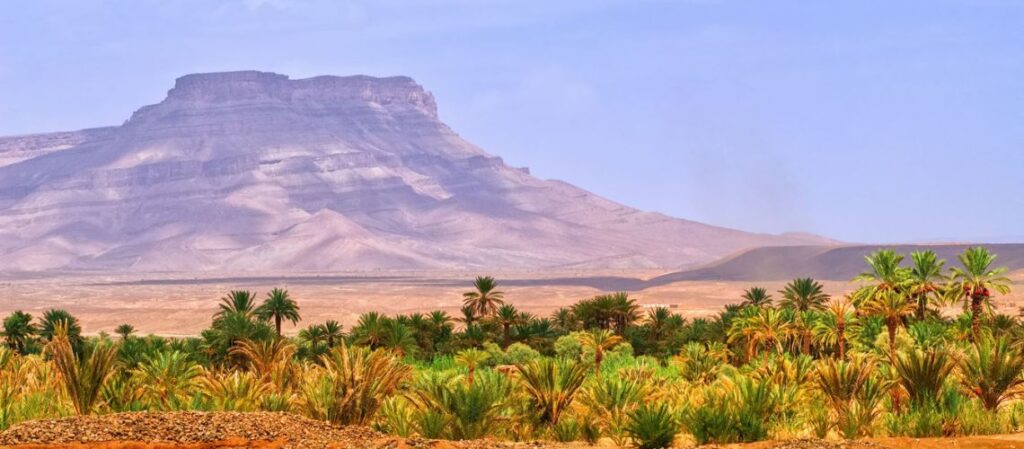
South of Ouarzazate, the Draa River has cut a valley through the pre-Saharan plateau that is one of the great geographic surprises of Morocco: a ribbon of green — date palms, olive trees, vegetable gardens — running through an otherwise arid landscape for over two hundred kilometres toward Zagora and, ultimately, the Sahara. The road through the Draa Valley is one of the finest drives in Morocco, and the sequence of ksour — fortified villages — kasbahs, palm oases and Amazigh villages along its length makes it as historically interesting as it is beautiful.
The town of Zagora, four hours south of Ouarzazate, was once famous for a road sign — ‘Tombouctou 52 jours’ — that pointed south toward the Sahara and has become one of the most reproduced images of Moroccan travel. The sign refers to the caravan journey to Timbuktu, which took fifty-two days by camel through the desert. The journey is no longer practical, and Zagora has something of the character of a destination that has traded on a legend. But the erg of Chegaga to the southwest — a sand dune field smaller and less visited than Merzouga but of extraordinary beauty — is accessible from Zagora and is, if anything, a better Saharan experience for its relative emptiness.
The Kasbah Taourirt
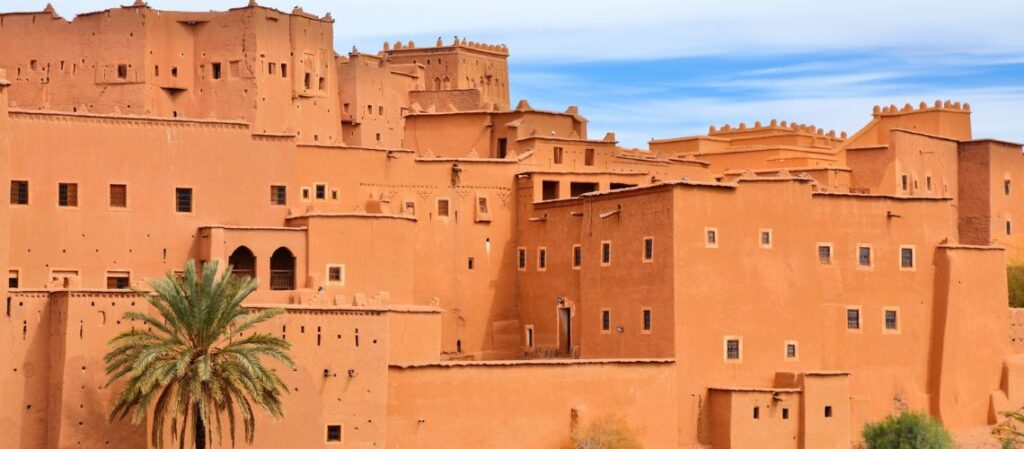
In the centre of Ouarzazate itself, the Kasbah Taourirt is the most significant historic monument in the city. Built by the Glaoui family — the powerful Amazigh clan that controlled southern Morocco through a combination of military power and French collaboration during the Protectorate period — it is an elaborate complex of towers, courtyards and domestic quarters that was once the residence of Thami el-Glaoui, the Pasha of Marrakesh who was one of the most powerful figures in twentieth-century Morocco.
The Glaoui family’s story is a complicated one. Thami el-Glaoui supported the French in their deposition of King Mohammed V in 1953, a collaboration that made him anathema in Moroccan nationalist history but that preserved his power through the final years of the Protectorate. After independence, the family was stripped of much of its property and influence. The kasbah — partly restored by UNESCO in the 1990s — is now open to visitors, and the contrast between the elaborately decorated reception rooms (where Glaoui entertained Churchill, among others) and the more austere Amazigh domestic quarters shows the social complexity.
The Light and the Landscape
The thing that draws artists and film makers to Ouarzazate is the light. It is a high-altitude desert light — dry, clear, intense, without the moisture-softening that you find on the Atlantic coast. The pies walls of the kasbahs turns gold, then amber, then deep red as the sun moves. The mountains in the north catch the snow light in winter and the pale rock light in summer. The desert to the south seems to absorb and then return the heat of the day in a shimmer that is not quite a mirage.
Spend two or three nights in Ouarzazate. Use the time to visit Aït Benhaddou in the late afternoon, to drive through the Draa Valley, to sit in the evening at a cafe watching the plateau light go gold. The city itself is modest and modern — no great medina, no overwhelming monuments.
But what it opens up, in landscape and history and the particular quality of southern Moroccan life, justifies the journey entirely.

One World is Enough
I’m Peter , the founder of the Inspirational Traveller. I set up One World is Enough 30 years ago after spending a year travelling around Asia in the mid 90’s. On my travels I met lots of talented artisans making the most amazing things, they just needed a market for them in the West.
So I started working with them, firstly through selling on market stalls and music festival stalls. This soon grew into a shop and then a bigger shop, then an online business. Now we send One World is Enough’s collection of fair trade clothes and crafts around the World.
We design and source all our products from our own network of fair trade producers.
We produce our own range of beautiful vibrant fair trade clothes and crafts for beautiful vibrant people!
We do this by working with our own team of lovely small scale producers in India, Nepal, Indonesia, Thailand, Laos, Morocco & Afghanistan.
All our designs are made in short runs, and when they’re gone, they’re gone!
The Inspirational Traveller
People kept asking about my travels to some of the more unusual, off the beaten track destinations that I travelled to. So I set up the Inspirational Traveller, as a curated travel guide.
I write these guides and itineraries, when I have the time, so it is a bit of a slow process, but I am adding more and more content, as I get the time.
The Inspirational Traveller is designed to a curated travel guide, to inspire you about places to visit, rather than be an exhaustive guide.
Hope you enjoy it!

 |  |  |  |